









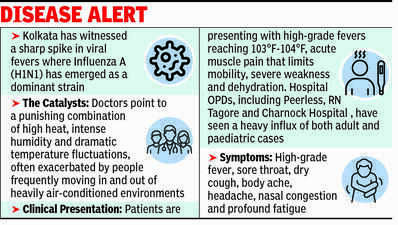
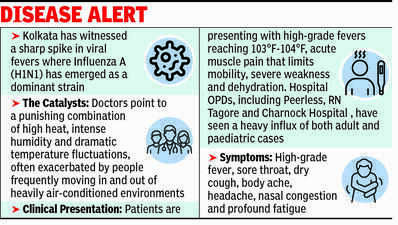
Kolkata: An outbreak of Influenza A or H1N1 has laid hundreds low across Kolkata with severe symptoms like high fever, body ache and chest infection, which, doctors say, has been triggered by the sharp temperature fluctuations over the last fortnight.For most, it has been starting out with a nagging cough and turning into lung congestion with an accompanying high fever. Several hospitals have seen a surge in severe influenza cases that required admission, including some in the ICU. Most are being treated at the outdoor, though.At the Peerless Hospital laboratory, four-five have tested positive for Influenza A per day since early this week. “At least four-five have remained admitted at a time over the last few days. Most have severe infection with symptoms like breathing distress and severe weakness. They also have comorbidities,” said Peerless Hospital chief microbiologist Bhaskar Narayan Chaudhury. He added that since few are tested for viral infections, the number suggests that the outbreak has affected thousands.While Influenza A cases have remained relatively high for a month, it has spiralled sharply over the last eight-ten days, according to Charnock Hospital pulmonology head Soumya Sengupta. The hospital has also been receiving a steady flow of children and young adults with rhinovirus, other than those with symptoms of Influenza, though few are being tested. “Initial symptoms are fever and cough, which are manageable for most. For those with a history of lung ailments like COPD or asthma, a persistent cough triggered by H1N1 leads to congestion and severe symptoms, which is happening this time. We have treated many with breathing distress, especially children and elderly patients, while a few are admitted,” added Sengupta.Influenza viruses thrive during periods of frequent weather fluctuations, particularly when alternating spells of heavy rainfall and intense sunshine are accompanied by persistently high humidity, like at present, according to BP Poddar Hospital consultant physician Satyaki Basu. “These conditions favour viral transmission, while increased time spent in enclosed, air-conditioned spaces and crowding in schools, workplaces and public transport further facilitate person-to-person spread. In my OPD, we are currently seeing an average of five -seven patients daily presenting with influenza-like illness, with symptoms including high-grade fever, sore throat, dry cough, body ache, headache, nasal congestion and profound fatigue. These numbers have increased considerably over the last two weeks, coinciding with the recent spell of erratic weather. While most patients recover with supportive treatment, we have admitted two patients with influenza-related complications, both above 50 years of age with multiple comorbidities, including COPD and uncontrolled diabetes.ILS Hospitals, too, has seen a similar surge along with some swine flu cases and a sharp rise in the number of respiratory patients with Influenza. Around 75% are Influenza cases, including a significant number of Influenza A cases.“Number of OPD patients has increased by 50%, including those with acute exacerbation of different respiratory illnesses, fever, cough, wheezing and breathlessness ,” said Mrinmoy Mitra, senior consultant pulmonologist. “There has also been a 20% increase in admissions with Influenza and swine flu cases, around 10% increase in ICU admission with severe respiratory distress associated with bacterial pneumonia. This is the high time to put your mask on, especially those with COPD, asthma, ILD, immunosuppression, elderly and children. In case you have severe symptoms, consult a pulmonologist .”Following a severe Adenovirus crisis in early 2023, the city entered a phase where Influenza A began attacking in tandem with other respiratory bugs, said experts. Rather than isolated outbreaks, medical experts tracked a “cocktail” of viruses where Influenza A circulated simultaneously with RSV, Rhinovirus and parainfluenza. This structural overlap meant that even when the primary fever subsided in 4 to 5 days, the upper respiratory tract irritation took anywhere from 4 to 6 weeks to completely clear up, heavily impacting asthmatic and elderly demographics.