








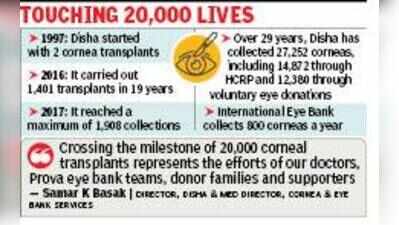
Kolkata: A city private eye hospital has completed 20,000 transplants this year amid a drop in cornea transplants in Kolkata and south Bengal. While requirement for eye transplants has reduced due to better treatment and awareness, Bengal still needs around 4,000 corneas a year, around 80% of which are provided to recipients.Since its inception in 1997, Disha Eye Hospitals has completed 20,000 cornea transplants, the highest among private establishments so far. It started with two in 1997 and reached a maximum of 1,908 collections in 2017 and 1,401 transplants in 2016. While all govt hospitals collect and transplant corneas, private initiatives have waned over the years.Disha’s efforts transformed the lives of thousands of patients suffering from corneal blindness, said Debasish Bhattacharya, chairman & managing director, Disha Eye Hospitals. “It is often difficult to reach and collect eyes due to logistical challenges and limited resources. Still, we have managed to collect over 1,500 corneas a year. It has dropped considerably over the past five years due to multiple reasons, including a drop in demand,” added Bhattacharya.International Eye Bank, a pioneer in eye donation in Kolkata, collects around 800 corneas a year through its 60 units that function independently. “Getting a healthy cornea is still difficult, especially if it has to be collected from a remote area. Our centres now run in coordination with nearest govt hospitals that have a 24×7 infrastructure to collect corneas. We also refer many to Disha from our Kolkata unit if a cornea has to be collected at an odd hour,” said Moloy Ray, vice-president of International Eye Bank.Over the past 29 years, Disha Eye Hospitals has collected a total of 27,252 corneas, including 14,872 through the Hospital Cornea Retrieval Programme (HCRP) and 12,380 through voluntary eye donations. Of these, 11,110 corneas from HCRP and 9,101 from voluntary donations have been successfully utilised for transplantation, reflecting an impressive utilisation rate of over 74%. The national average is just above 50%.Corneal blindness remains one of the leading causes of visual impairment, and corneal transplantation continues to be the only sight-restoring treatment for many. The Hospital Cornea Retrieval Programme has played a pivotal role, accounting for over half of all corneal transplants performed.In recent years, voluntary eye donations have also witnessed a remarkable rise, reflecting increased public awareness and participation. Greater awareness, accessible and improved treatment had significantly reduced vision loss over the years, said Ratish Pal, secretary of Susrut Eye Foundation. “While we have more donors now, the requirement has dropped, which is a positive sign. But we need to maintain the current numbers,” said Pal. Susrut collects 250 corneas a year and transplants around 150.“Crossing the milestone of 20,000 corneal transplants is not just a number—it represents 20,000 lives touched, 20 ,000 families given hope and the collective efforts of our doctors, Prova eye bank teams, donor families and supporters over nearly three decades,” said Samar Kumar Basak, director, Disha Eye Hospitals & Medical Director, cornea and eye bank services.One of the most encouraging trends is the growing awareness about the importance of regular eye check, said Suhana Datta, consultant ophthalmologist, BP Poddar Eye Hospital. “This is enabling us to diagnose vision-threatening conditions, such as glaucoma, diabetic retinopathy, age-related macular degeneration (AMD), retinal vascular disorders and retinal tears or detachments at an earlier stage, when treatment is most effective and the likelihood of preserving vision is higher,” said Datta.