










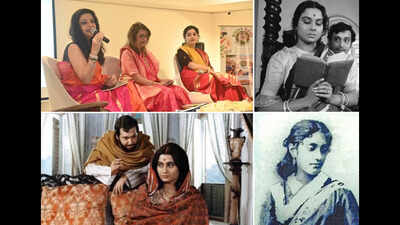
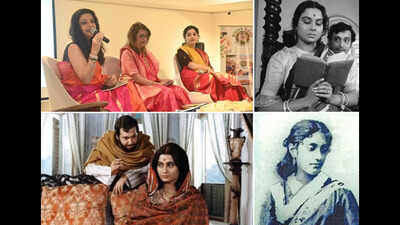
What if Charulata and Bimala, two of Tagore’s most restless heroines, were handed a second chance and a 2026 calendar, and Kadambari Devi had a different ending to her life? Playwright, author and singer Isheeta Ganguly’s book Three Womenexplores just that question. She put forth this question to a Kolkata audience on Thursday evening at the KCC, in a discussion moderated by Rita Bhimani, with dancer and academician Dr Souraja Tagore on the panel. Isheeta’s also treated the audience to her renditions of Tomarei Koriyachi Jiboner Dhrubotara, and Pathohara Tumi Pothik Jeno Go where Souraja indulged the audience with an impromptu dance accompaniment.A letter, a cough and a conversation with RayThe idea, Isheeta said, began at Brown University, in a student-led course on Tagore’s women. She wanted to put forth her questions to Satyajit Ray himself, and at 18 or 19, she left a letter in his mailbox. Within 24 hours, Ray called and asked her to meet him next evening. What stayed with her was Ray as “an incredible feminist”. That conversation planted a seed: what if Charu and Bimala had a different ending? Second chances, she said, are a recurrent theme in her life – from her mother’s generation and its unrealised dreams to Kadambari Devi. “What if women could have a second chance? What if men could have a second chance?” she asked. “What if she could become who she really wanted to be, which was to be a writer?” Of the unresolved way Kadambari Devi’s life ended, she said, “I felt her soul was screaming.”
I have been in love with Tagore’s heroines ever since I discovered them in a course at Brown University during my college years. His heroines felt like a ‘home’ to me in that they were and are so relatable to women of today – whether Gen X or Gen Z. Tagore’s heroines have always been inherently ambitious, brilliant, curious, seekers and at the same time sensitive to the struggle of defining and balancing “self” in the context of the external world. In 2026, women are still in that same quandary of negotiating how much to “lean in” or “step back”…When do we assert ourselves and when do we hold back? Charu, Bimala and Kadambari have been reimagined to women of today through their adventures with today’s urban jungles and finding their purpose through self love
Isheeta Ganguly
A play built like a songIsheeta says music is her biggest support and her love for that always translates into her writing. She structured the play like a song: “Act I is the Antara, Act II is a Sanchari, Act III is the Abhog”, following a hero’s journey through its highs and lows to a resolution. With her work in musical theatre – Three women – a musical theatrefirst premiered in 2014 – she quickly learnt the power of multi-media work “to stir audiences from a multi-sensoral perspective”. Audiences, she says, are carried by music, dance and dialogue “in ways that transcend the pages of a script”.
True empowerment was to be able to choose who you really wanted to be, and to be productive and at the end of the day, to be happy
Dr Souraja Tagore
Tagore, learnt by earTagore reached Isheeta through music before the page. Growing up between the US, Turkey, Indonesia and Japan, she credits her late parents, Indrani and Rathin Ganguly, as “the artistic lights” of her life, and her mother in particular for keeping his music alive “across our travels and homes all over the world”. Her mother oversaw her training in Rabindrasangeet with Suchitra Mitra and in Hindustani classical with Vijay Kicchlu during a year in Kolkata. Isheeta released Visva-Bharati-approved albums from the age of 15. That grounding, she says, let her innovate “in a constructive manner”. Years of research went into the notation (swaralipi) as a singer, and into the history of Tagore’s heroines and the real Kadambari Devi through available texts. For Isheeta, bringing them to 2026 felt like a natural progression of women’s stories and lives from then to now. Audiences in New York, Kolkata, Chicago, Mumbai and Singapore, she finds, connect equally with the work’s themes of identity, reinvention, purpose and love.