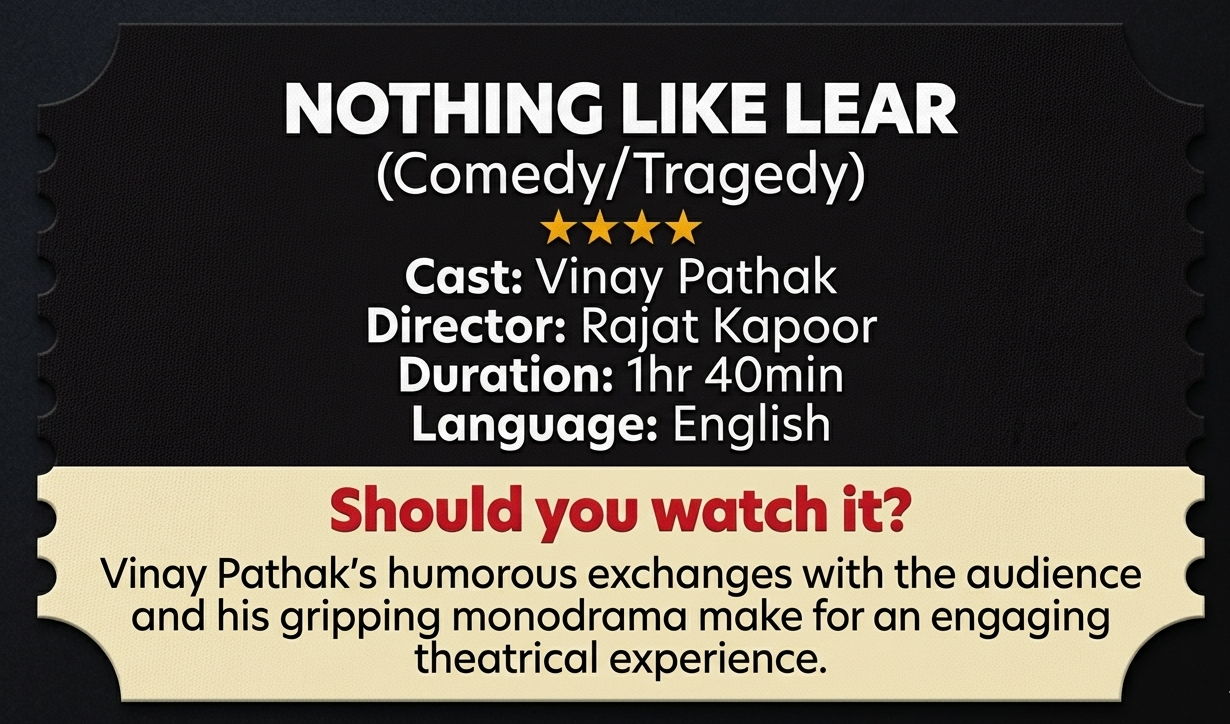








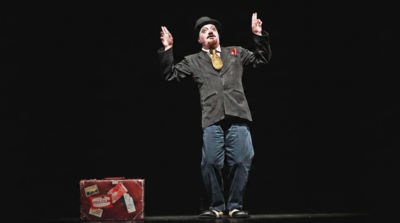
“I laugh, therefore I’m a fool.” When Vinay Pathak delivers this line as the goofy clown in Nothing Like Lear, it’s almost as if the play is tipping its hat to the Fool in King Lear, building on the line “Jesters do oft prove prophets.” While the play draws heavily on the core concept and central characters of one of Shakespeare’s most celebrated tragedies, the title offers a cheeky disclaimer right at the outset that it’s nothing like the original in form and structure. Thanks to the witty script, it’s nearly impossible to box the play into a straightforward adaptation of the original.The opening scene teases the audience into a playful tug-ofwar between belief and disbelief. Even before the lights dim and the crowd can settle in, Pathak, dressed as a Chaplinesque tramp, ambles onto the stage and declares, “It hasn’t started yet.” The actor-narrator draws the audience into a gripping solo act filled with witty one-liners that carry an undercurrent of quiet sadness, making it hard to separate fact from fiction. The clown’s rambling storytelling leaves the audience wondering whether what they’re witnessing is the real act or a play within a play.The audience interactions punctuate the play’s flow, offering comic relief. The audience becomes an invisible character, with Pathak playing along and feeding off its reactions.As the clown recounts snippets from his life, some trivial, others carrying a lingering impact, the play constantly oscillates between tomfoolery and the macabre. Pathak holds the audience’s attention for nearly two hours as the worldly-wise clown, balancing humour with subtle emotional depth. The play infuses the Shakespearean tragedy with everyday human experiences and explores filial and fraternal relationships in the modern context, adding a contemporary layer to the centuries-old tale of intra-familial drama.