









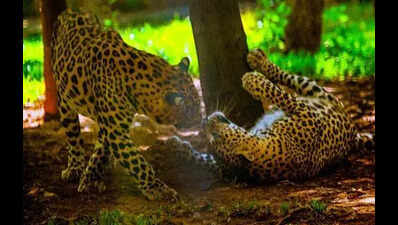
Thane: A leopard was spotted during the 12-hour wildlife survey conducted in the Yeoor range of Sanjay Gandhi National Park (SGNP) on May 1, ending concerns about its absence from last year’s count. Activists, however, say the lone presence this year offers limited comfort, as overall the sightings remain significantly lower than what was recorded in 2024 (see box).Further, the 2026 survey recorded 34 total wildlife sightings, which is less than a quarter of the 152 recorded in 2024 and sharply lower than the 61 recorded in 2025, underscoring a continuing decline in the overall visibility of species in the region.Activists and locals attribute the trend to increasing human pressure and infrastructure activity along forest fringes, which they believe is affecting wildlife movement and sightings, particularly of elusive species like the leopard.“The leopard being seen again is good news, but it does not necessarily indicate an increase in population,” said a wildlife enthusiast. “Overall numbers are still significantly lower than two years ago.”“The data indicates Yeoor’s wildlife is being impacted by rising human activity along the fringes,” said Rohit Joshi of the Yeoor Environment Society. “Encroachments and commercial activity around the forest, along with ongoing construction and drilling at adjoining infrastructure projects, are disturbing nocturnal wildlife and pushing them deeper into the forest, affecting visibility during such counts.“A glance through the study shows that while sightings of monkeys and langurs continue to decline, wild boar and sambar deer show marginal improvement, though both remain well below 2024 levels. The 2026 survey also recorded smaller mammals such as the palm squirrel and Asian palm civet, while porcupines went missing this year.Forest officials, however, urged caution in interpreting the findings, stressing the limitations of short-duration observations. “These are snapshot surveys, and animal presence is majorly influenced by weather conditions and movement towards water sources deep inside the forest,” said a forest official. “Absence during a 12-hour window does not mean disappearance of species. We are now introducing camera-based monitoring to improve accuracy in real-time counting of wildlife numbers.““We still see wildlife, including leopards, but sightings have reduced as forest edges are increasingly turning into concrete developments with bungalows and turfs,” said Ramesh Walvi, a resident of Wanicha Pada in Yeoor. “Wild animals tend to avoid human presence, which could explain lower census counts.”