









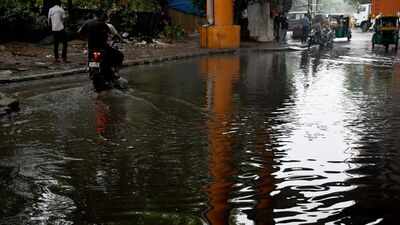
NEW DELHI: E20 petrol is fine. Get the road sorted first. This is what my app-based cab driver told me as I got in the back seat for my short journey from South-West Delhi to my office in Central Delhi on 7 July 2026.At first I smiled, thinking it was just another passing comment about traffic or politics. But as our car bounced over potholes, uneven patches and broken stretches of road for the next hour, I understood he was talking about something deeper – the economics of driving on India’s roads.
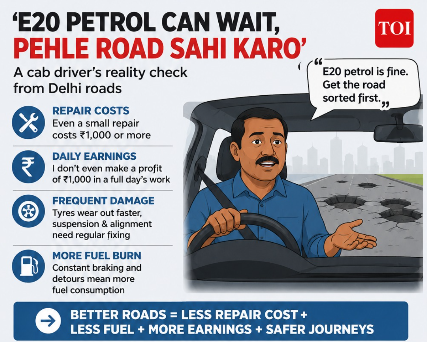
Cab driver’s reality check from Delhi roads.
Our conversation was broken off by a thud as the car hit a pothole. “This is our biggest problem, sir,” he said, pointing ahead at another damaged section. “E20 petrol is still being talked about but who is talking about these roads?”He explained he drives almost 150 to 250 kilometres everyday for an app-based cab service. “His car is his entire life. Every vibration, every pothole and every badly repaired road slowly destroy it. “Even a small repair costs Rs 1,000 with mechanics,” he said. A suspension problem, wheel alignment, tire damage or bent rim cost a lot more. Sometimes it just takes one bad pothole.His voice sounded more exasperated than angry. “I don’t even make a profit of Rs 1,000 working the entire day,” he told me. “Imagine spending a whole day’s income just because of one bad road.”The repair costs have become a regular part of his monthly expenses” he said. Tyres wear out quicker. Suspension parts wear out more often. Wheel balancing and alignment are no longer occasional jobs but regular maintenance. “When the passengers complain about the ride, they think we are driving bad,” he said. “They don’t realize we’re trying to save the vehicle from damage.”
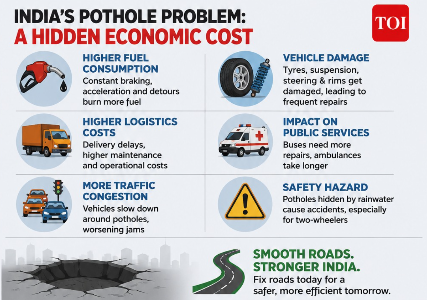
India’s pothole problem
We drove on, and he carefully navigated around dozens of potholes, slowing down and speeding up again and again. The constant braking also causes more fuel consumption, he said. “People think fuel efficiency is only dependent on the engine or the quality of petrol,” he said. “Bad roads also cause us to burn more fuel.”Then he returned to the topic that had begun our conversation. “I am not against E20 petrol,” he clarified. If it helps India reduce oil imports and pollution, that’s good. But the government should fix the roads first. What is the use of cleaner fuel if the vehicles are getting damaged everyday?”His argument was simple and practical. Road quality, he said, impacts every aspect of a driver’s life, from income, vehicle upkeep, fuel costs and passenger comfort to safety. “If roads get better,” he said, “I will automatically save fuel, spend less at the mechanic and earn more. That will do me more good than anything.”By the time I reached my office, I realised that what had seemed like a casual remark at the start of the trip was, in fact, an economic argument rooted in everyday experience.E20 petrol means cleaner mobility, lower crude oil imports and more energy security. But the immediate problem for my cab driver was to survive another month without an expensive repair bill.His priorities reflected the ground realities of millions of drivers in India.The bigger issue: India’s pothole problemMy driver’s experience is not unique. Potholes are a perennial problem on Indian cities and highways during the monsoon season, wreaking havoc on traffic and adding to the economic burden of millions of commuters, commercial drivers and logistics operators.Potholes are more than just an inconvenience while traveling. Vehicles constantly brake, accelerate and take detours, which means higher fuel consumption. They cause damage to tyres, shock absorbers, suspension systems, steering parts and wheel rims, with regular repairs. These costs directly eat into the daily earnings of commercial drivers like cab operators, truckers, delivery personnel and auto-rickshaw drivers.The problem is far greater than any individual motorist. Delays in delivery increase logistics costs. Public buses require additional repairs. Ambulance response times are longer. Traffic jams are worsened when vehicles slow around damaged parts. And every extra litre of fuel burnt in stop-go traffic leads to higher carbon emissions.Road safety is another big issue. During monsoon season, potholes can fill up with rainwater and become difficult to spot. These hazards are especially dangerous for motorcyclists and cyclists and sudden changes of direction to avoid potholes are often the cause of multi-vehicle collisions.India’s ambition to use cleaner fuels like E20 petrol is an important national ambition. Reducing our dependence on imported crude oil and reducing emissions are noble goals. But cleaner fuel alone cannot overcome the inefficiencies caused by poor road infrastructure.Regardless of the fuel being used, smooth, well-maintained roads improve fuel efficiency. They cut repair costs, improve road safety, boost productivity and reduce emissions all at the same time.Perhaps that is why my cab driver’s words still ring true. “First fix the road, E20 petrol can wait.”That simple sentence is a reminder that infrastructure and environmental policy should be two sides of the same coin. Cleaner fuel is important but so are roads that allow every driver to earn a decent living and every litre of fuel to be used efficiently.