







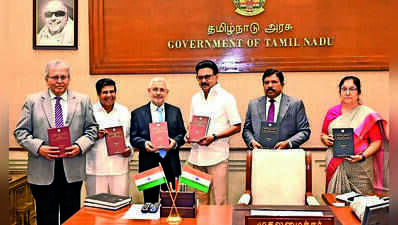
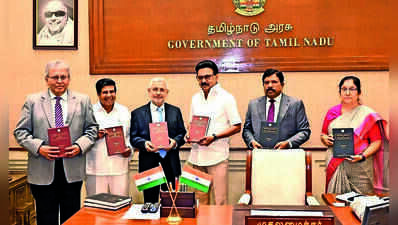
R S RaveendhrenCan reports submitted by govt committees duly constituted on public funds and tabled in the legislative assembly be commercially exploited by private parties? Can any such report be denied free access to the public? These and other queries are likely to vex anyone interested in downloading the English version of the first report submitted by the high-level committee on Union-state relations under the chairmanship of Justice Kurian Joseph.Tamil Nadu has the unique distinction of consistently pushing for a constitutional structural reset and, in the process, becoming the first state in India to seek substantial constitutional reforms by appointing the Justice P V Rajamannar Committee in 1969.On April 17, 2025, the DMK-led govt had constituted a high-level committee under the chairmanship of Justice Kurian Joseph, which included retired IAS officer Ashok Vardhan Shetty and former vice-chairman of Tamil Nadu Planning Commission M Naganathan. The committee was tasked with examining contemporary federal challenges posed by constitutional, fiscal, and institutional developments and with making actionable recommendations aimed at restoring federal balance and strengthening genuine federalism within the constitutional framework.The committee submitted Part I of its report to the govt in English and Tamil on Feb 16. It was proudly announced that the Tamil version would be available with open access, with a press note clarifying that once the report was tabled in the TN legislative assembly, the vernacular version would be uploaded to the govt website. Once uploaded, any individual or institution is permitted to print, reproduce, and distribute the text in whole or in part, if the source is duly acknowledged and there are no alterations made to the text.The idea behind it is the wider dissemination of the report and the promotion of an informed public discourse on the subject. The report therefore became a public document on Feb 16 upon its tabling in the legislative assembly.While the Tamil version was freely available right after tabling, there was no official communique for a long time about its English version. An extensive search made it clear that it was not made available in the public domain. However, on March 19, publishing house ‘Bloomsbury Publishing India Private Limited’ released the English version of the same Report-I submitted by the committee as a hardbound book, priced at `799. The paperback is priced at `699. A quick browse shows that very little care has been taken to format and align the content, making it hard to hold or to read.The committee’s official website (http://hlcusr.tn.gov.in) until June 7 expressly disclosed that the Tamil Nadu govt had assigned copyright to Bloomsbury for the English version of the Report-I for three years, and that the Bloomsbury edition is available on Amazon and through leading booksellers. The website has subsequently revised its content, and all references to the assignment have now been removed. Further, the book, which is printed and bound by Manipal Technologies Limited, Manipal, claims to be co-published by the Tamil Nadu Textbook and Educational Services Corporation, whose role is dubiously vague and undefined.A committee report qualifies as ‘govt work’, and the govt is the ‘first owner of its copyright’ under the Copyright Act of 1957. This statutory protection for govt work secures it from falling into unscrupulous private hands, thereby protecting the public.Per Rule 283(1) of the Tamil Nadu legislative assembly, only speaker of the house can authorize printing, publishing and sale of report(s) laid on the table of the house.To a query raised through the RTI Act on June 12, the office of the Speaker has categorically stated “that no copyright permission has been granted so far to any private publisher for the commercial exploitation of the contents of committee reports laid on the table of the house”. In this context, it is baffling to note that a private publishing house is now claiming copyright over the English version of a committee report, which is, by every means, a ‘public document’.To specific queries made with the public department seeking to see the policy note for the decision to assign copyright in favour of a private publisher and to know whether any notice inviting tender was published for such assignment of copyright, for knowing consideration received for such assignment and to view a copy of the deed of assignment, the public information officer has cautiously refused to divulge any information. Supreme Court has held in a plethora of cases that the right of a citizen to obtain information on matters relating to a public act flows from their fundamental rights enshrined in Article 19(1)(a).This reluctance to part with information on copyright assignment relating to a public document made in favour of a private party for commercial exploitation, to the exclusion of others, raises serious questions about public accountability and transparency in the govt process. Assigning such copyright has undermined the majesty of the legislature and clearly constitutes a breach of privilege, amounting to contempt of the house.Assigning copyright to a third party has ousted a person’s right to free access to the committee report’s English version. A govt represents the will of its people. Ownership of a commission report with the govt is in the nature of trust. Real ownership vests only with the people. An elected govt allowing a private enterprise to monetize its committee report is prima facie obnoxious and impermissible.Mahakavi Bharathi, when quizzed about copyright, had said that he wished his works were accessible like kerosene and a matchbox.The past administration’s attempt to expropriate the English version of Justice Kurian Joseph’s committee report-I and to dispossess the public of its free access appears to have an illicit, monopolistic motive and needs to be redressed emergently to undo the damage to people’s trust.(The writer is an advocate in Madras high court)