







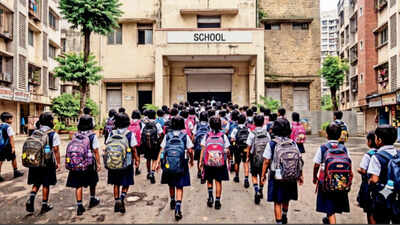
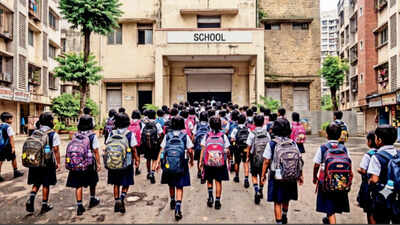
MUMBAI: In Baiganwadi, Govandi, the morning rush begins before the school bell. Traffic chokes the narrow roads as autorickshaws, two-wheelers and pedestrians jostle for space. Students in uniforms stream into the lanes, while inside one of the neighbourhood schools, a teacher wipes the blackboard clean before the day’s first lesson.For the children, it’s an ordinary school morning. For their schools, however, the future is far less certain.
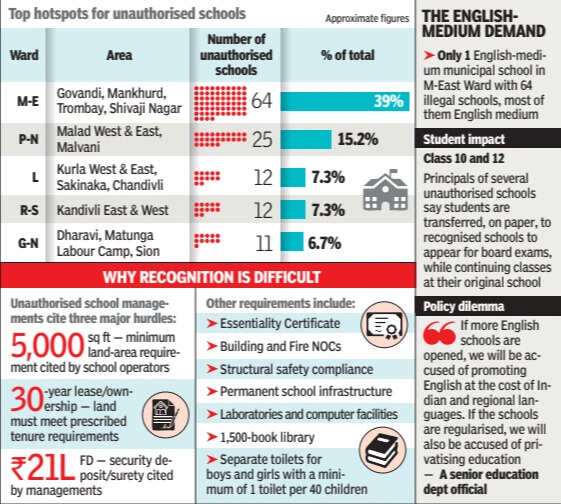
Top hotspots for unauthorised schools
M-East Ward, covering Govandi, Mankhurd and Trombay, accounts for 64 (39%) of the 164 unauthorised schools identified across Mumbai, making it the city’s largest cluster. About 36 schools here have been served closure notices, with FIRs against some.Many operate from cramped one-to-three-storey premises, with small classrooms, old wooden benches and, in some cases, children seated on floors. School managements say obtaining recognition is difficult in slum pockets where land is scarce.School management officials said the requirements for schools include a minimum 5,000 sq ft plot, a 30-year lease or ownership of land, an Essentiality Certificate and building and fire clearances, besides prescribed infrastructure and sanitation facilities and a fixed deposit of Rs 21 lakh.“No one can give you an assurance of even one or two years in a slum, and they want a 30-year lease,” said a teacher at a Baiganwadi school with 800 students. The school has an FIR registered against its management. “We have met the authorities multiple times, and have been given eight months to figure out things,” the teacher said.For parents, the lack of recognition is not always apparent. Aslam Siddiqui, an actor and parent at the school, said he was unaware of its status. “I broke my leg last year. The school was close to my home, so I could walk her here.”Multiple principals of unauthorised schools said students in classes 10 and 12 are, on paper, transferred to recognised schools through an arrangement between the two institutions and appear for board exams under the recognised school’s name. Their school-leaving certificates carry the recognised school’s name, although they attend classes at the unauthorised school.Around 90% of the 164 unauthorised schools have the word “English” in their names, reflecting the aspiration for English-medium education in slum pockets. In M-East Ward, there is just one English-medium civic school, catering to around 1,100 students.In L Ward, another hotspot covering Kurla-Sakinaka, across Asalpha station, Pereirawadi is home to Prerna High School, which has functioned since 1993. It was originally a Marathi-medium aided school, but enrolment shrank by early 2000s, with even govt teachers declared surplus.In 2011, the school switched to English and applied for recognition. Its management says infrastructure requirements have been completed, but recognition remains pending because the school cannot get its name on the 7/12 land record. Owner and lawyer Devendra Hande said, “For the past 15 years, we have been regularly going to the education department. We were even on a list of schools to be regularised but we have inevitably dropped out.” On the shift to English, he said, “People from humble backgrounds, like domestic workers, aspire to send their kids to an English-medium school because they think it’s a gateway to a better life.”Principal secretary (school education) Ranjit Singh Deol said approvals and regularisation for 47-48 schools may soon happen, but safety remained a concern. “The main reason why approvals are not given easily for such schools is because of the physical structure. They operate without any structural and fire audits and, in the case of an accident, if lives are lost, who will take responsibility?” BMC education officer Sujata Khare said, “We have shifted 2,000 students and plan to eventually shift most to municipal schools.” On the shortage of English-medium civic schools, she said, “There are private aided schools they can go to.”A senior official said govt also faced a larger political and policy dilemma: “If more English schools are opened, we will be accused of promoting English over regional languages. If the schools are regularised, we will be accused of privatising education.”A former teacher, who opened a school in Govandi in 2020, said, “This entire slum is BMC land. We cannot be its legal owners, yet we have rent receipts.” He said instead of mandating 5,000 sq ft, it would be practical to focus on the number of seats per class. If schools are indiscriminately closed, he fears dropout rates will rise. “We want to be recognised, but norms should be different for slums. The same infrastructure standards for a school in Colaba should not be imposed on Baiganwadi.“