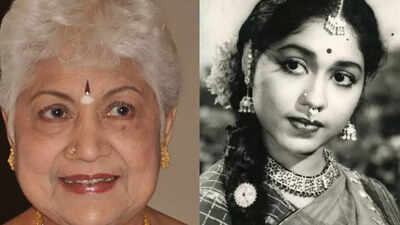










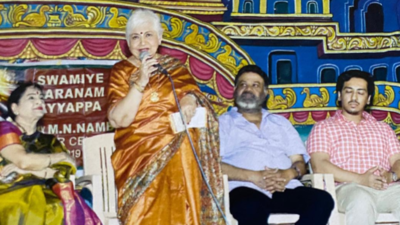
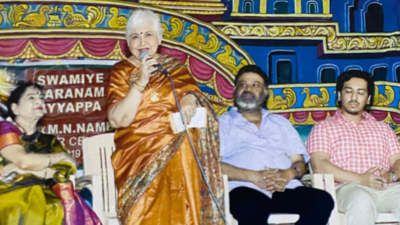
CHENNAI: By the time Sowcar Janaki met K Balachander, she did not need to be discovered. She was already a name, bankable, carrying an image the industry had settled on without asking her: the actress who cried beautifully. What Balachander did was not launch her. It was something rarer — he took an established star and showed everyone, audience included, that they had only been watching a fraction of what she could do.Their story didn’t begin on a film set. It began in the wings of a stage production called ‘Mezhuguvarthi’. Balachander wanted Janaki for the play but hesitated to ask directly — she was, after all, a film star being invited into amateur theatre. It was Major Sundarrajan who made the approach, and Janaki said yes without much fuss. Balachander would later describe what happened next in family terms: she simply became part of the troupe.Janaki herself has said it was theatre, not cinema, that truly introduced her to Balachander, and that she went on to perform with his group extensively. The professional trust that would define their film collaborations was built first in rehearsal rooms, long before any camera rolled.That trust travelled with them into film, and it travelled in stages. ‘Bama Vijayam’ (1967) let her step into social satire, a register far from the melodrama she was known for. ‘Ethir Neechal’ (1968) went further — Balachander later said he cast her knowing full well that audiences had boxed her into tearful, suffering roles, and he wanted to break that box on purpose. ‘Iru Kodugal’ (1969) pushed in yet another direction, handing her the role of a district collector wrestling with a messy, complicated past — a part built on restraint and moral weight rather than tears. By the time ‘Kaaviya Thalaivi’ (1970) arrived, with Janaki playing both mother and daughter, it was clear this wasn’t a series of one-off experiments. It was a filmmaker steadily expanding what one actress was allowed to be on screen.What Balachander seemed to understand — perhaps before Janaki fully did herself — was that her gifts went well beyond the tragic register she’d become synonymous with. Her comic timing wasn’t manufactured through gags or exaggeration; it came from character, from the specific rhythm of how a person might actually speak and pause and react. Janaki has credited Balachander directly for helping her locate that comic instinct, pointing to ‘Bama Vijayam’ and ‘Ethir Neechal’, and later ‘Thillu Mullu’, as the films where that side of her fully emerged.The partnership also worked because it was genuinely collaborative, not just well-cast. Janaki has spoken about how Balachander welcomed her input on her own performances — how she’d study a character’s costume, mannerisms, and inner logic, and how he was open to what she brought back to him. That kind of creative latitude was not a given for actresses of her generation, which makes it worth noting on its own.Iru Kodugal stands out for another reason: Janaki, by her own account, wasn’t someone who went around asking directors for roles. She made an exception for this one, actively seeking the part of the collector. What she delivered — a performance of authority and control with real emotion churning underneath — became a demonstration of exactly what Balachander had spotted in her: sophistication that didn’t come at the cost of dramatic depth.The final proof arrived over a decade later, with Thillu Mullu (1981). Here was the “tragedy queen,” once defined by grief and sacrifice, holding her own in an outright comedy opposite Rajinikanth, steering entire scenes through expression and timing alone. Looking back, Janaki herself said that Bama Vijayam, Ethir Neechal and Thillu Mullu together had given her “a different status” in her career — not a rebrand, but a genuine widening of what people understood her to be capable of.