









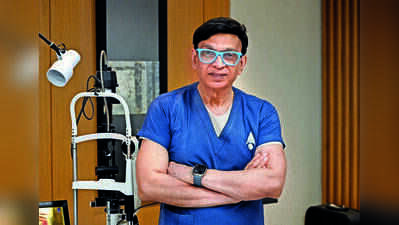
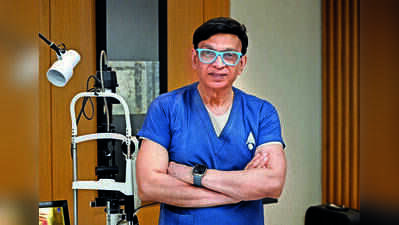
Dr Agarwal’s Health Care, founded in 1957 in Chennai, will enter its 70th year in Dec. Over the years, the chain has innovated and introduced new technologies in eye care. In an interview, chairman Amar Agarwal spoke about expansion and technology. Excerpts:How has the business evolved over decades?When we started, our parents came to Chennai with Rs 100 in their pocket. Dr Agarwal’s Hospitals started with one hospital. In 2002, we started exploring the franchisee model, though it did not work for us. Since 2006, we have started setting up our own branches. From Chennai and Tamil Nadu, we have expanded across the country. We have about 310 hospitals in India and 10 in African countries. The Cathedral Road facility, built in 1976 is the flagship centre. Fifty years later, it is being redeveloped as Dr Agarwal’s Eye Hospital Main Centre, which will be inaugurated this Dec. It will be a state-of-the-art centre with one lakh sqft of space spanning more than 10 floors.What is your expansion plan, and which will be the key growth markets?We operate on the hub-and-spoke model. We have 25 hospitals in Chennai. Of these, three are the main hospitals functioning with different specialties. At the other hospitals, basic cataract procedures and surgeries are carried out. Complex cases are referred to the main hospital. In TN, we have 88 hospitals. We will reach 150 in the state over the next five years. In total, we will have 800 in five years. This year, we target opening two hospitals every week. Currently, we see more than 25,000 patients a day. We will see approximately one lakh patients a day once we have 800 facilities across India and overseas. We are looking to enter the Gulf Cooperation Council (GCC) region and will launch facilities in the UAE soon.What is the capex for next five years?Over the next five years, about Rs 2,000 crore-Rs 2,500 crore will be invested. We are located in 14 states, and we will be present in every state over the next five years. Eye care is the fastest-growing single specialty in healthcare, and the entire eye care market is expected to grow at 12%-14% over the next three to four years. We will be growing above the market rate, targeting a growth of 20%-25%.What role will tech and surgical innovation play in your next growth phase?Technology has been central to our progress, but we place a higher premium on human innovation. Technology is an enabler; it is the surgeon’s ability to innovate that creates breakthroughs. Two techniques developed inhouse illustrate this. Pinhole pupilloplasty uses a simple optical principle to address severely irregular corneas. Instead of a corneal transplant, the technique reshapes the pupil into a small central aperture, blocking distorted peripheral light and restoring functional vision in selected patients in a single sitting. The glued intra-ocular lens (IOL) addresses another long-standing problem. Neither technique required a new machine — both came from rethinking the surgery itself.How do you balance investment in tech with need to keep eye care affordable?Technology raises costs only when volumes are low. At scale, the same equipment used across a high-volume network carries a much lower per-patient cost, allowing us to introduce advanced platforms without pricing patients out. A large part of our investment also goes into developing surgical specialists and techniques rather than just buying equipment. Several innovations, including pinhole pupilloplasty and the glued IOL, came from rethinking procedures rather than investing in new machines. Innovation should improve care, not restrict access.