








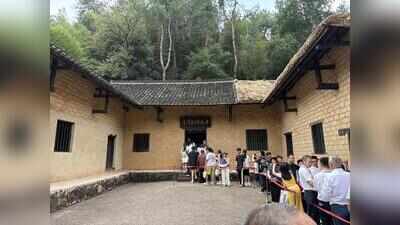
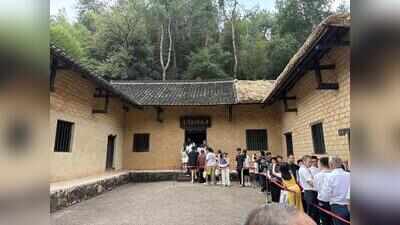
China is actively promoting Nanjing and Changsha as international tourist destinations, positioning the two historically rich cities as compelling alternatives to traditional hotspots like Beijing and Shanghai.Nanjing, capital of Jiangsu province in eastern China and one of China’s Four Ancient Capitals, draws visitors primarily for its layered historical heritage. Its most significant — and sobering — landmark is the Memorial Hall of the Victims in the Nanjing Massacre by Japanese invaders.The Japanese Army occupied Nanjing, then the capital of the Republic of China, on Dec 13, 1937. Over the following three months, around 300,000 civilians and prisoners of war were killed, according to historical accounts.Within the memorial complex, the remains of around 10,000 people were recovered, some of which have been preserved and displayed as part of the site’s historical documentation.“Thousands of people visit the memorial every day from Jiangsu and other provinces of China, as well as from different countries. The govt has taken steps to promote Nanjing as a global tourist destination, with the memorial playing a central role,” said local travel guide Geng Huan.Beyond the memorial, Nanjing is encircled by one of the largest city walls ever constructed in China. Its Nanjing Museum — one of the earliest established in the country — holds a permanent collection of more than 400,000 items, reflecting how China’s rapid modernisation has not pushed its history into the background.The city is also a significant academic hub, home to 68 institutions of higher learning including Nanjing University of Aeronautics and Astronautics and Nanjing University’s School of Astronomy and Space Science.Changsha, capital of Hunan province, offers a sharply different experience. A manufacturing powerhouse that has developed rapidly — with skyscrapers, shopping malls, ring roads and long flyovers — it nevertheless remains deeply connected to China’s modern political history.The city sits close to Shaoshan village, the birthplace and former residence of Mao Zedong. The residence has 18 rooms, including 13 small rooms with green-tiled roofs in the eastern section where Mao’s family once lived.Domestic and international tourists queue outside the residence and at the adjacent Mao Zedong Square, where a bronze statue of Mao stands.Local guides say Shaoshan village and the square attracted around 12 million visitors last year. The Mao Zedong Memorial Hall in Shaoshan documents his life, career, ideas and personality, drawing visitors interested in China’s modern political history.Jinggang Ancient Town is another major draw in the Changsha region. Once a natural deep-water harbour and a prosperous commercial centre for distributing goods across Hunan, it today attracts visitors with its historical heritage, picturesque water-town scenery and rich folk traditions.(The writer was in China from Aug 16 to Aug 22 at the invitation of the Chinese consulate in Kolkata)