





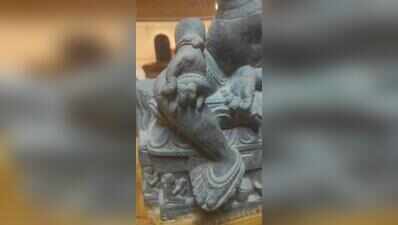
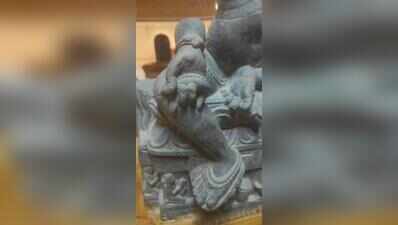
Patna: A centuries-old sculpture discovered in Lakhisarai may offer an important clue to the history of “perakiya”, one of Bihar’s popular festive sweets. The crescent-shaped sweet, now a familiar feature of celebrations across the state, could have a history dating back nearly 900 years.The sculpture was discovered in 2024 by Anil Kumar, former professor of Ancient Indian History at Visva-Bharati University and currently director of the Bihar Heritage Development Society, along with three students, while exploring a mound at Rahugarh in Lakhisarai.It depicts two objects resembling traditional sweets, one crescent-shaped and the other circular. Kumar said the crescent-shaped object bears a striking resemblance to “perakiya”, while the circular one resembles “Chandrakala”, another sweet popular in Bihar and Bengal.Kumar said an inscription on the sculpture dates it to the reign of King Rampala, one of the last powerful rulers of the Pala dynasty, in the late 11th century. The inscription records Vamana Mahidhara, son of confectioner Kanduka Devdhara, donated the sculpture at Mahisona, a village that continues to exist in Lakhisarai district.The reference to Kanduka as a confectioner is significant, Kumar said, as it suggests the community was present and economically prosperous in the region during the 11th century.The findings of Kumar and Rajat Sanyal, epigraphist, department of archaeology, University of Calcutta, have been published in Journal of Bengal Art, Dhaka, Bangladesh, as essays in honour of Gerd J R Mevissen 2026.The sculpture has been preserved at Lakhisarai Museum since its discovery. Assistant curator Dilip Kumar said its depiction offers a striking visual link with the “perakiya” eaten in Bihar today.The discovery could add a new chapter to the history of Bihar’s traditional sweets, suggesting “perakiya” may have much deeper historical roots than previously known.