








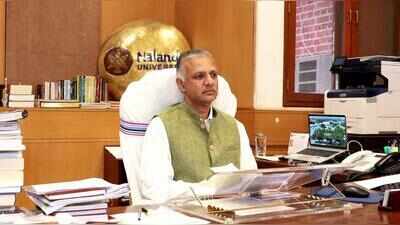
Patna: Delivering a lecture at Nalanda University titled “What Made Nalanda Special” in Sept 2026, Professor Shailendra Raj Mehta offered a reminder easy to forget amid invocations of India’s ancient learning: from the sixth century BCE to the 12th century CE, India evolved scattered hermitages into a functioning university system. Takshasila, Nalanda, Vallabhi, Vikramashila, Odantapuri, Jagaddala and Somapura formed an ecosystem in which innovations in pedagogy, logic and debate were tested, refined and transmitted.As this system was eclipsed, European universities rose and independently rediscovered many of the same innovations before adding their own. This raises an obvious question: what made the original ecosystem generative, and can that generativity be lived and taught rather than merely commemorated?This is what a new foundation course, the “Nalanda Spirit”, seeks to answer. Every student entering a master’s programme now spends the first two months in an intensive, 30-hour, credit-bearing course. It is not a heritage module. Students learn scholarly conversation in the “shastrartha” tradition, stating an opposing position, the “purvapaksha”, at its full strength before advancing their own. The course concludes at the excavated Mahavihara, testing textual testimony against archaeological evidence. The pedagogy is the argument: knowledge is trustworthy only when method survives contact with evidence.That emphasis on method points to something the ancient system took for granted and modern academia has largely forgotten. Nalanda brought natural sciences, social sciences and humanities into one pursuit; pancha-vidya and the 64 kalas were not separated into faculties that did not speak to each other. Today’s complex problems do not respect departmental walls either. The ecological crisis needs science alongside an ethical account of interdependence; artificial intelligence needs philosophy and classical logic alongside statistics. Our most urgent problems already refuse to specialise.There is another dimension to this recovery. Knowledge frameworks, from development metrics to international relations and the periodisation of progress, still predominantly reflect Global North vantage points. A foreign-policy question about West Asia read from Washington outward may be incomplete when viewed from India’s historical position. Likewise, the millennium development goals, sustainable development goals and what follows 2030 land differently across national, linguistic and cultural contexts. The “Nalanda Spirit” asks students to recognise the frame they were taught by default. The Global South need not merely reform global knowledge institutions; it can help reshape their epistemic foundations.On June 19, 2026, addressing the Issyk-Kul International Forum in Kyrgyzstan, the governor of Bihar, Lieutenant General (Retd.) Syed Ata Hasnain, described Nalanda as “the greatest international university of the ancient world” and set out the Nalanda Approach: influence through education, research, innovation and civilisational understanding. He called this “power through knowledge” and proposed renewed academic and cultural partnerships between Bihar and Central Asia.The ideas born at Nalanda did not die with the institution; they migrated, resurfaced and were claimed by others. Our task is to ensure that migration again runs in more than one direction. Nalanda is best understood as a working model, not a silhouette. Reviving its spirit, rather than merely commemorating its ruins, is the more demanding and useful inheritance.(The writer, Sachin Chaturvedi, is vice-chancellor of Nalanda University. The views expressed are personal)