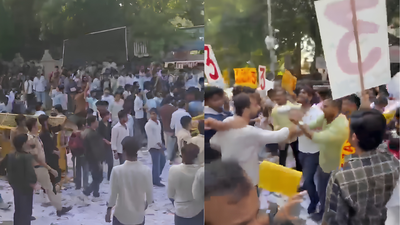




New Delhi: In Delhi University, where student union elections, particularly the presidential contest, have long remained a Jat-versus-Gurjar battle, NSUI has fielded Vijay Shankar Meena, an Adivasi student from Rajasthan, for the top post this year – a move that marks a break from a pattern that has long dominated the DUSU presidency.From 2010-11 to 2025-26, every DUSU president has been a Jat or Gurjar, with the two communities also dominating ticket distribution by ABVP and NSUI. In the 13 DUSU elections held in that period, ABVP won president’s post nine times — while seven winners were Gurjars, two were Jats. NSUI won the presidency four times — all winners were Jats.The dominance is visible not only in who wins, but also in who gets the ticket in the first place, with Jat and Gurjar candidates repeatedly preferred for the presidency.This year, however, NSUI has picked Meena, who belongs to the Scheduled Tribe (ST) community. Originally from Rajasthan, Meena describes himself as a first-generation learner — the first in his family to pursue higher education and come to DU. He joined the university for his MA and is currently pursuing his postgraduate studies in Buddhist Studies. Both his parents are persons with disabilities and the family’s livelihood comes from farming, with others cultivating their land.In a campaign video, Meena’s father Ramji Lal spoke of the family’s limited means and said they had little understanding of higher education or even what their son was studying.“My wife and I are both disabled, so we are not able to do farming. We have given our land on rent. They take half the produce and give half to us. This is how we live. My wife also does stitching, and that is how we earn our livelihood,” he said.“Neither I nor my parents studied. He is the first in my family who studied till Class 12 in the village. In Delhi, he appeared for some examination… We have no knowledge of education. He only told us he had got admission and wanted to go to Delhi,” he added.The visible involvement of parents in this year’s campaign is unusual. Deepanshu Shokeen, an NSUI member from the Jat community, decided to contest the vice-presidential election as an Independent after a dispute over ticket distribution. Shokeen has also been campaigning on campus alongside his father.Meanwhile, ABVP has fielded Yash Dabas, a Jat candidate from Kanjhawala in Delhi’s rural belt, for president; Ishu Maurya, an OBC candidate from UP, for vice-president; Riya Chhawadi, a Gurjar from south Delhi’s Molarband, for secretary; and Lakshya Raj Singh, a Rajput from Rajasthan’s Shekhawati region, for joint secretary.NSUI’s panel comprises Meena for president; Vir Chatrath, a Punjabi, for vice-president; Namrata Choudhary, a Gurjar from Karawal Nagar, for secretary; and Gopal Choudhary, a Jat from Rajasthan’s Mewar region, for joint secretary. Several candidates from Rajasthan are also in the fray.Notably, the NSUI panel selection this year has faced opposition from several members and supporters within the organisation, with some like Shokeen eventually entering the contest independently after disputes over ticket distribution. Samarth Beniwal, another name linked to the NSUI camp, is in the presidential race as an Independent. Beniwal later clarified he is not in dispute with the organisation, but continues to remain in the presidential race.This year’s fight is not a simple two-way contest. The traditional NSUI-ABVP contest is facing a challenge from the Left, which has sought to carry the energy of recent student movements into the election. The AISA-SFI alliance has fielded Ananya Raturi for president, along with candidates who have been associated with recent protests, including the one at Jantar Mantar over the NEET paper leak.These issues have resonated strongly with sections of the youth, triggering a wider GenZ mobilisation around examination failures, unemployment and concerns over the education system. The protests eventually became part of the political pressure that preceded Dharmendra Pradhan’s resignation as education minister.