


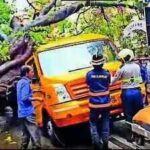


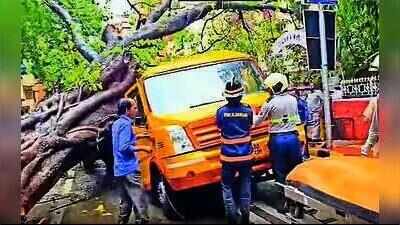
Mumbai: Multiple factors caused a peepal tree to crash on a school bus, killing an 11-year-old in Chembur on June 30, according to the fact-finding report submitted to BMC on Tuesday.The tragedy occurred near Diamond Garden in Chembur when the large tree crashed on a school bus. Vihaan Srivastava (11) was killed and four other schoolchildren were injured.The inquiry report submitted to BMC commissioner Ashwini Bhide has pointed to a combination of factors that may have contributed to the tree’s collapse, while also examining the difficulty of visually identifying trees that may be at risk of falling.The report, prepared by former Mumbai University vice-chancellor and botanist Prof Sanjay V Deshmukh, who was appointed to independently reinvestigate the incident, was submitted to BMC on Oct 6 after more than two months of inquiry.It is learnt that the report has not fixed responsibility on any individual or authority. Instead, it has examined the sequence of circumstances that culminated in the tree falling on the school bus near Diamond Garden.A significant aspect of the inquiry is its assessment of the tree itself. The report has examined the fact that the peepal was an old tree and looked at its biological and structural condition, including the factors that could have affected its stability over time. The inquiry has also highlighted a larger challenge before civic authorities—there may not always be visible external signs that allow a person to accurately determine whether a seemingly healthy or standing tree is at risk of uprooting or crashing.The report has also examined whether multiple interventions and activities around trees can cumulatively compromise their stability. In particular, it has looked at utility lines and underground works, stressing the need for such utilities to be properly mapped so that excavation does not inadvertently affect a tree’s root zone or weaken its foundation.The inquiry has gone beyond simply examining the point at which the tree fell. Deshmukh reassessed the available evidence and scientifically evaluated observations contained in the preliminary inquiry. The report examined the incident through several disciplines, including engineering, botany, environmental science, meteorology, soil science, drainage, road construction and public administration.It has also examined circumstances surrounding the school bus, including why it had stopped at the particular location and issues relating to insurance in such incidents.The inquiry is understood to have also considered the role of soil and drainage conditions, road-related works and weather conditions in assessing how the tree’s stability may have been affected. Rather than identifying one immediate cause, the report attempts to establish the chain of factors that ultimately led to the tree crashing.The fact-finding report is the first part of the exercise ordered by BMC following the June 30 tragedy. Deshmukh is yet to submit two other components of the assignment dealing with policy recommendations on urban forestry. “One of the three policy documents have been submitted to BMC few days ago,” said a source privy to the developments.These recommendations are expected to focus on what needs to change in the way Mumbai manages its trees and surrounding infrastructure to prevent similar incidents. The policy component is expected to address tree-risk assessment, protection of root zones, coordination of utility works and other preventive measures.The report’s broader finding is significant for the city’s tree management system: preventing such deaths may require looking beyond the tree itself and examining what has happened around it over the years—from excavation and utilities to soil, drainage, road works and weather—rather than relying only on a visual inspection of the tree.