








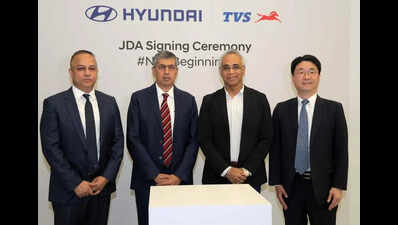
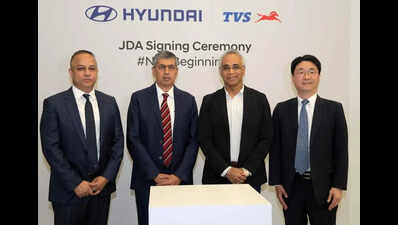
Chennai: Hyundai Motor Company and TVS Motor Company have formalised a partnership to develop and commercialise electric three-wheelers, targeting India’s fast-growing last-mile mobility market and potential exports to other emerging economies.The companies said on Monday they had signed a joint development agreement to co-design and manufacture a new generation of battery-powered three-wheelers, a segment that underpins urban transport and logistics across India.“We hope the co-developed E3W enables broader access to safer and more sustainable transportation for people across the country,” said Joongsun Ko, Senior Vice President of Corporate Strategy & Planning at Hyundai Motor Company.The collaboration follows the unveiling of a concept vehicle at the Bharat Mobility Global Expo 2025 and marks a shift from prototype to production. Carmaker Hyundai will lead design and contribute research and development capabilities, while two- and three-wheeler maker TVS will focus on engineering, manufacturing and distribution, drawing on its established presence in the domestic three-wheeler market, according to a statement.“By bringing together complementary strengths — including our electric three-wheeler platform, engineering expertise, and deep understanding of customer needs — we are well-positioned to deliver purpose-built products for India and additional markets,” said Sharad Mishra, President, Group Strategy, TVS Motor Company.The partners aim to tailor the vehicle to Indian operating conditions, including congested cities and monsoon-affected roads, while keeping costs competitive through extensive localisation of components. Production will be based in India, with TVS expected to oversee domestic sales and future exports.India is the world’s largest market for three-wheelers, widely used for passenger transport and goods delivery. The government has been encouraging electrification of the segment to curb urban pollution and reduce dependence on fossil fuels.The companies said they plan to bring the first model to market after completing testing and regulatory approvals, with features designed for tropical climates, extended daily usage, and multiple applications ranging from passenger mobility to cargo and emergency services.