






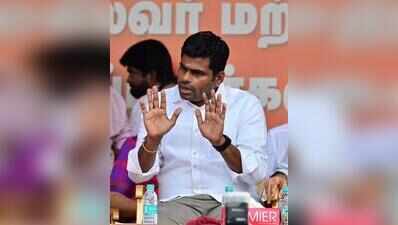
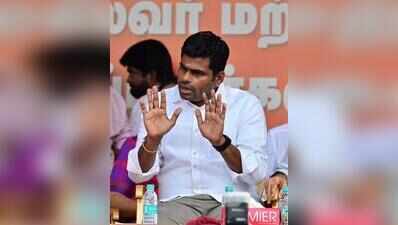
“The Annamalai of today, will be stale 20 years from now. There will be younger, better and hungrier people who should lead,” says Annamalai Kuppusamy. But for now, the 42-year-old has chosen to take the lead, attempting something few politicians willingly do — walk away from an established political party at the height of their influence, and start afresh.The former Tamil Nadu BJP president, who resigned from the party after six years, and launched the ‘We, The Leaders’ (WTL) movement, insists his decision was not driven by personal ambition or political grievance, but by a conviction that the state needs a new political culture.A former IPS officer who served in Karnataka, Annamalai quit the civil service to enter politics and joined BJP on Aug 25, 2020. Within a remarkably short span, he emerged as the party’s most visible face in Tamil Nadu. Mentored by Union home minister Amit Shah and BJP national general secretary B L Santhosh, he spearheaded aggressive campaigns against the previous DMK govt, undertook state-wide yatras and helped expand BJP’s footprint among younger voters.Yet, after becoming one of the BJP’s most recognisable leaders in the South, Annamalai chose to walk away, reinvent himself and, potentially, TN politics. For him, politics is not merely a contest for power but an exercise in constant reinvention. Confident that age and changing voter demographics are on his side, the leader is now crafting a political formula tailored to Tamil Nadu’s dramatically evolving political landscape.“I continue to be a strong nationalist,” he says. “I believe in the unity of the country. At the same time, I believe all states should compete to be the best version of themselves.”That balance between nationalism and regional aspiration lies at the heart of his political philosophy. Annamalai argues that Tamil Nadu’s politics should be shaped in Tamil Nadu, not dictated from Delhi. While he repeatedly stresses that he harbours no resentment towards BJP, he speaks candidly about what he calls a “vision mismatch” with the national party.“In BJP, I felt, the pathway to leadership in Tamil Nadu was stuck for many people,” he says. One of the disagreements, he says, was over the locus of political decision-making. “Tamils feel decisions are made in Delhi. For the sake of Tamil Nadu, I don’t think that is good politics. Relationships will continue to remain civilised, but not friendly,” he says of his future interactions with Prime Minister Narendra Modi and Home minister Amit Shah.He adds, “Each state should have strong regional grassroots leaders, so India remains strong as a plural nation.” His departure, however, was far from impulsive. The idea had been germinating for nearly two years. Annamalai credits his fellowship at Oxford University’s Blavatnik School of Government in 2024 for giving him the intellectual space to reassess politics and governance.“My fellowship allowed me to look at politics from an academic perspective,” he says. Travels across India, Europe and the US reinforced his belief that democracies worldwide are undergoing change, driven by youth aspirations, disenchantment with traditional parties and demands for greater accountability.“What might have been the right kind of politics in 1980 might not be the right kind of politics in 2026,” he says. The churning led him to conclude that his future lay outside a national party structure. “I felt my time was up in a national policy framework,” he says.Annamalai believes the 2026 Assembly election result transformed Tamil Nadu’s political landscape and reflected deeper political currents that established parties failed to recognise. Actor-turned-politician Vijay’s TVK rode a youth wave and anti-incumbency sentiment to power, ending decades of Dravidian dominance.“The demographics have changed. The voters have changed. There is no going back,” he says. Unlike many political leaders, Annamalai is generous in acknowledging Vijay’s impact. “Sometimes you need a cult or a cinema star with a strong cinematic sense to break certain things that were holding politics back such as money power, caste equations.”At the same time, he draws a distinction between electoral success and governance. “Tamil Nadu needs governance centric, evidence-based leaders,” he says. Annamalai believes the scale of anti-incumbency against DMK played a major role in the election outcome. “Anti-incumbency against DMK was so strong, one of the reasons for Vijay’s victory,” he says.His assessment of the previous govt is blunt. “DMK govt was corrupt.”The new govt deserves time, he says. “Give Vijay a year.”As for AIADMK, he believes the party failed to adapt to changing political realities. “People, leaders have to adapt, change to circumstance with proper spirit of friendship and cooperation and alliance,” he says. “Politics has changed, political parties have to change, otherwise they are doomed.”Annamalai admits he opposed AIADMK’s return to the NDA fold. “I never supported AIADMK coming in. My party couldn’t find me a seat to contest,” he says. Looking back, he believes an AIADMK-BJP-TVK alliance would have backfired.“DMK would have come back to power in that case. This election showed that people saw chemistry more than arithmetic.”He is equally candid about what he sees as the limitations of national parties in Tamil Nadu. “National parties don’t speak the language of Tamil Nadu. That is my genuine criticism of all parties, including BJP.”At the heart of WTL, he says, is the idea of generational change. Unlike traditional political organisations built around a “supreme leader”, Annamalai says the movement will have term limits, age limits and leadership rotation.The movement is currently focused on membership expansion, civic campaigns and leadership development rather than electoral politics. WTL claims nearly 19 lakh members and aims to reach 50 lakh before considering its transition into a political party. “By-elections is not our game,” he says.Among its flagship initiatives is a plan to nurture future leaders. “We want to launch an Abdul Kalam fellowship for young political leaders, groom them, guide them for a year, take care of their expenses, give them that financial freedom to go to grassroots, and experience the joy of service.” Underlying many of his ideas is a moral critique of contemporary politics.“Mahatma Gandhi considered politics without principle, and money without work as cardinal sins. We want to bring this culture,” says Annamalai. For now, he rules out alliances. “I don’t see that we will align with anybody.” Nor does he foresee joining hands with Vijay. “We are against any degrading political culture. We are different from TVK. We are different from Vijay’s model of politics.”He also speaks with unusual candour about past political relationships. “I continuously pushed for T T V Dhinakaran and O Panneerselvam to be a part of an extended NDA. I share a valuable friendship with Dhinakaran.” On former chief minister O Panneerselvam, he is particularly emotional. “It is unfortunate what happened to OPS. It was one of the saddest days of my life. I made my misgivings clear to the party when OPS joined DMK.”When asked about suggestions that he was merely a BJP experiment, Annamalai dismisses the characterisation. “I can proudly say Annamalai was always Annamalai within BJP.” Nor does he accept the notion that he owes the party more than he gave it. “I think it’s a fair compromise where the party gave me an opportunity and I also did my best as a karyakarta.”Ultimately, his politics rests on a dual identity. “I am an Indian first. But I am proud to be a Tamilian.” Whether WTL eventually becomes a major political force remains uncertain. But Annamalai is betting that Tamil Nadu’s future belongs to younger leaders, grassroots movements and a politics less defined by hierarchy and more by participation.If his experiment succeeds, it could redefine how politics is organised in Tamil Nadu. If it fails, it will still stand as one of the boldest attempts in recent years to challenge the conventions of Indian party politics.