







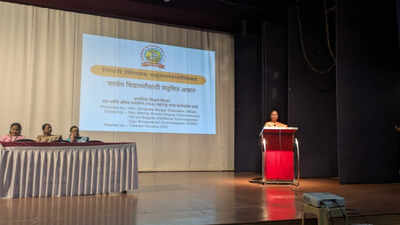
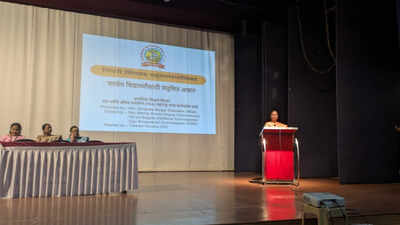
MUMBAI: Rising childhood obesity and unhealthy lifestyle habits are no longer just individual health concerns. As per UNICEF, India ranks second globally after China for childhood overweight and obesity, with an estimated 41 million children affected aged 5 to 19 years.Against this backdrop, a school-based health initiative is crucial to shift the focus from treating chronic diseases in hospitals to preventing them through health education in schools, say doctors.Recently the FDA, Maharshtra started an education campaign for schools in the state whereby officials educated not only students but also administrators to ensure that access to unhealthy food is banned completely while the school explores healthy options.Pediatricians are now backing this move and calling for a strict implementation.The Indian-American Medical Community has been spearheading this Initiative in the US since some time now.At a pledge-signing event hosted by The Wright Center for Community Health in Scranton, Pennsylvania, in June, organisations including the Global Association of Physicians of Indian Origin (GAPIO) and the American Association of Physicians of Indian Origin (AAPI) announced their support for the ALIGN Health Initiative, a school-based preventive health programme, has begun rolling out across US school districts with a simple premise: if chronic disease begins with habits formed in childhood, then health education has to begin there too.The programme sends physicians directly into schools to run interactive sessions on nutrition, movement, sleep, mindset and healthy habits — five “stations” that students rotate through, followed by take-home material meant to pull parents into the conversation as well.The campaign, Healthy Kids, Healthy Future, aims to equip children with the knowledge and habits needed to make healthier food and lifestyle choices early in life, recognising that prevention is far more effective than treating chronic disease years later.Dr Vriti Khurana, founder of the ALIGN Health Initiative, said: “Many students never receive practical education on nutrition, physical activity, sleep, stress management and healthy lifestyle habits,” said Dr Vriti Khurana.“ALIGN was created to help close that gap through engaging, physician-led health education delivered directly in schools.” The programme, offered free of cost to host schools, currently targets students between the ages of eight and fourteen — an age band researchers consider the last real window for altering lifelong habits before they set in.Dr Amit Chakrabarty, AAPI’s president said he was “totally amazed” by the initiative. Ratan Agarwal, President of WHEELS Global Foundation, one of ALIGN’s partner organisations, said, “Nearly 100 doctors from the US and India are already working on WHEELS projects spanning telehealth, sanitary pads, and post-partum depression”.He added that the health missions in the US and India are converging faster than most people realise. Dr Vikas Khurana, a senior advisor to ALIGN, said WHEELS Global Foundation is aiming to reach 20 percent of India’s population by 2030, a reminder that for many in this network, the US and Indian health missions are really one continuous project.Dr Raj Shah, Chairman, Health Council and Board Member of WHEELS Global Foundation, supported the initiative and agreed with ALIGN’s vision that children are at the centre of medicine.For India, where childhood obesity and diet-related non-communicable diseases are rising alongside persistent malnutrition, the initiative offers an important lesson: the future of healthcare may depend less on expanding hospitals and more on transforming schools into the first line of defence against chronic disease.That continuity matters, because India’s own numbers are moving in a worryingly similar direction. Roughly 1 in 4 Indian school children is now obese, with unhealthy diets squarely to blame, according to recent estimates.A study in the Indian Journal of Community Medicine found children who ate fast food and sweets more often, and less fruit, were significantly more likely to be obese — with lenient parents compounding the risk. Its researchers concluded the fix would need intervention “at the level of schools, families and community.”For India, adapting such a model to local needs could allow schools to play a larger role not only in education but also in preventive healthcare.The larger question for India is whether the country can move beyond a predominantly hospital-based approach and make school-level prevention a stronger part of its public-health strategy to address childhood obesity and lifestyle-related diseases.