







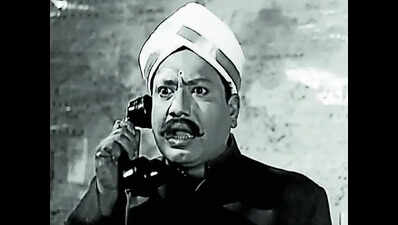
Tamil cinema has known many Ramasamys: K R Ramasamy, the singing star of yesteryear; ‘Friend’ Ramasamy and ‘Pulimoottai’ Ramasamy, comedians of an earlier era; and ‘Cho’ Ramasamy, the incomparable satirist. Yet there was none like V K Ramasamy, either as an artiste or as an individual. He was not merely an inimitable comedian and supporting actor but an institution unto himself, an actor whose popularity endured for decades, a film producer, stage artiste, writer and, above all, a chronicler of the golden age of the Tamil stage.His stature was all the more remarkable because it co-existed with a life that was anything but conventional. Open about his fondness for the bottle — he admitted in the mid-1970s that alcohol had consumed half his earnings over two decades — and blessed with an engaging temperament, he inspired affection wherever he went. A father of four, he later married Ramani, the former wife of his jailed friend, the actor M R Radha, and became the foster father of two of her sons. His candour and generosity earned him much goodwill, though they often left his finances precarious, a predicament compounded by his fondness for the turf (betting on horses? Can we say that?).Born 100 years ago in Virudhunagar, in the deep south of the Madras Presidency, Ramasamy was a bright eighth-standard student. His father, an oil-presser and merchant, dreamed of seeing him get a college education and a white-collar job. But a single encounter changed his destiny. One afternoon, when he came home from school for lunch, he found that his cousin V C Mariappan, an actor with Yathartham Ponnusami Pillai’s boys’ company, had come on a visit. Dressed in a silk shirt, sporting a gold ring, gleaming ear-studs and the fashionable ‘Bhagavathar’ crop, Mariappan seemed the embodiment of theatrical glamour. Ramasamy was overwhelmed. He ran away from home twice to join the drama troupe camping in Ponnamaravathi, more than 100km away, but was brought back by his elder brother. The third time, he jettisoned his books and fled to the now familiar destination. His father allowed the experiment to continue for a year before bringing him home, setting up a shop and placing him in charge. But the arrangement lasted only until it became clear that nothing, not family pressure nor commercial responsibility, could extinguish his determination to become an actor.In later years, veteran stage artiste Yathartham Ponnusamy would recall V K Ramasamy as an actor blessed with innate talent and a gift for sparkling repartee. During his stint with the Yathartham troupe, VKR befriended T K Ramachandran and later joined the drama company he founded. The pair flourished there for four years, and when it folded, moved to NSK Nadaga Sabha. There, their performances in the family drama ‘Naam Iruvar’ won wide acclaim. The play became VKR’s passport to the screen. Barely 21 years old, he essayed the role of the ageing banker Shanmugam Pillai with such conviction that he more than held his own against veterans like K Sarangapani and B R Panthulu.The breakthrough notwithstanding, V K Ramasamy did not find it easy to establish himself in films. Five years later, in 1952, came another significant opportunity in ‘Parasakthi’, the landmark debut of Sivaji Ganesan. As the predatory blackmarketeer who attempts to molest the film’s destitute heroine, VKR delivered a performance that left a lasting impression. Having shared the stage in their drama company days, Sivaji and VKR remained close friends all along. In his autobiographical reminiscences, Sivaji would single out VKR as one of the rare actors capable of essaying any role with conviction.An illustration of that versatility may be found in ‘Paar Magale Paar’ (1963), where VKR’s character delivers a scathing denunciation of the social pretensions and misplaced sense of prestige embodied by the role played by Sivaji. Such performances seemed to come naturally to him, yet he was never one to take his craft lightly. For a song sequence in ‘Lakshmi Kalyanam’ (1967), in which he had to lip-sync to lines sung by Sirkazhi Govindarajan and match steps with Sivaji, VKR rehearsed tirelessly on his own. By the day of the shoot, his devotion to perfection had taken its toll: his legs were swollen, and he found himself confined to bed!VKR was among the few artistes who enjoyed warm personal and professional relationships with M G Ramachandran and Sivaji Ganesan. He appeared regularly in MGR’s films during the late 1960s and 1970s. In the film ‘Pallandu Vazhga’, he played Mayandi, a barber and one among a group of hardened criminals whom MGR’s character attempts to reform through Gandhian methods. In a memorable scene, Mayandi is urged by his fellow inmates to slit MGR’s throat while shaving him. Unable to bring himself to commit the act, he abandons the attempt midway. MGR was delighted with VKR’s performance and congratulated him after the shoot. The actor, however, had a rejoinder ready. “Forget the performance, Sir,” he said. “I should be thanking you for trusting me with your neck.” The remark left MGR in splits.Rajinikanth and Kamal Haasan worked with VKR in their fledgling years and continued to benefit from his presence after rising to stardom. In a gesture mirroring the generosity of his on-screen character in the 1997 ‘Arunachalam’, Rajinikanth shared the film profits among eight struggling colleagues and mentors who had supported him during his early years in cinema. VKR was among them.Directors of a younger generation, notably Mani Ratnam, cast him in films such as ‘Mouna Ragam’ and ‘Agni Natchathiram’, and Malayalam director Fazil worked with him in three films including ‘Arangetra Velai’. Their confidence in him testified to a rare distinction: V K Ramasamy remained an indispensable character actor through successive eras of Tamil cinema, from the age of the drama companies to the threshold of the new millennium.(The writer is a historian of Tamil cinema)CALLING THE SHOTSVKR teamed up with A P Nagarajan to produce four films including ‘Makkalai Petra Maharasi’ (1957) and ‘Nalla Idathu Sambandam’ (1958)Played the lead in the stage play, ‘Rudrathandavam’ (1976) and reprised the role in its cinema version (1978) under his own production. Made five other films.‘Jodippura’ (1983), directed by VKR and produced by his foster son M R R Raghu, had his son V K R Raghunath in the lead roleVKR’s ‘Enadhu Kalaippayanam’ is an extensive chronicle of the golden age of Tamil theatre