






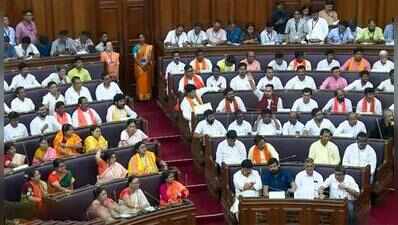
Kolkata: The Bengal assembly on Monday passed two amendment bills aimed at overhauling the legal framework governing reservations for OBCs, specifying 66 communities (54 Hindu and 12 Muslim communities) outside the SC and ST categories will be eligible for OBC quota. The new framework reduces 65 Muslim sub-groups (from the previous TMC govt-set framework) and nine Hindu sub-groups.The previous state govt had revised the OBC list first to 113 sub-groups with 77 Muslim and 36 Hindu sub-groups. In 2025, this was struck down by the Calcutta High Court. The govt then revised this to 140 sub-groups which had 77 Muslims, but 63 Hindu sub-groups. The HC had put a stay on this, but the Supreme Court had vacated the stay. Now the OBC classification has reverted back to the pre-Trinamool 66 OBC sub-groups.The bills passed on Monday also restored greater powers to the West Bengal Commission for Backward Classes while scrapping the statutory recognition accorded to a list of OBC communities under the previous Trinamool govt.The West Bengal Backward Classes (Other than Scheduled Castes and Scheduled Tribes) (Reservation of Vacancies in Services and Posts) (Amendment) Bill, 2026 and The West Bengal Commission for Backward Classes (Amendment) Bill, 2026 were introduced by state backward classes welfare minister Gaurishankar Ghosh and passed after a division in the House.The amendments seek to undo changes introduced by the TMC govt in 2012.BJP had repeatedly alleged that the TMC govt extended OBC benefits disproportionately to Muslim communities while overlooking several socially and educationally backward Hindu groups.Under the amended law, the state govt, in consultation with the West Bengal Commission for Backward Classes, will determine the percentage of reservation for OBCs and may revise it periodically. However, the overall reservation ceiling will remain capped at 50%. The govt will also be empowered to classify OBC communities into different categories based on the degree of backwardness, following the commission’s recommendations.The amendment to the West Bengal Commission for Backward Classes Act, 1993, allows individuals to apply for inclusion in the OBC list and raise objections regarding over-inclusion or under-inclusion of communities. The commission’s recommendations on such matters will be binding on the govt.In May 2024, the Calcutta High Court cancelled all OBC certificates issued after 2010, observing that the process adopted by the state govt for inclusion of communities in the OBC list was legally unsustainable. After assuming office in May, the BJP govt reduced reservations for OBCs to 7% from the earlier 17% through a notification reservation for 66 OBC classes in the state.“The backward classes commission will conduct inquiries and if it feels any community should be included, it can make recommendations. The previous govt had bypassed the commission and that is why the HC struck down the process,” the minister said.While the tenure of the commission members will continue to be three years, the state govt will determine the tenure of the member-secretary, who will be a serving govt official.Following the release of the Ranganath Misra Commission report, the Left Front govt introduced OBC reservations in the state. Based on the criteria of backwardness, a reservation of 10% and 7% was allocated for the two divisions, ‘Category A’ and ‘Category B’, respectively. In 2010, Jogesh Chandra Burman, the minister-in-charge in Buddhadeb Bhattacharjee’s cabinet, tabled a bill to that effect.After coming to office, the TMC govt amended that law in 2012. At that time, a list of 65 communities for reservation under ‘Category A’ and 78 communities under ‘Category B’ was added within Schedule-1. Christians converted from Scheduled Castes were also kept under ‘Category B’.