









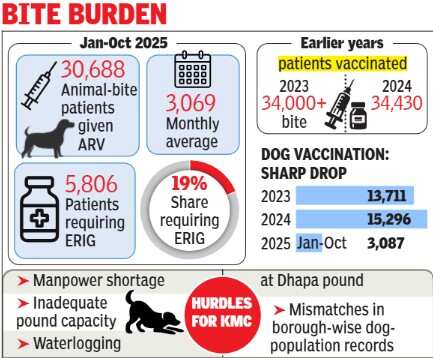
KOLKATA: More than 30,000 animal-bite patients sought anti-rabies vaccination at KMC clinics in just 10 months last year even as the civic body vaccinated 3,100 street dogs. The data exposes a widening gap between treating people after bites and preventing rabies at its source.KMC’s 2026-27 budget shows that 30,688 animal-bite patients received anti-rabies vaccine (ARV) between Jan and Oct 2025, or nearly 3,100 every month. Of them, 5,806 — almost one in five — also required equine rabies immunoglobulin (ERIG), generally administered for severe Category III exposures, said an animal activist working in the field of stray dog immunisation.Over the same period, however, KMC vaccinated only 3,087 street dogs and sterilised 932 male dogs. The contrast assumes significance on World Rabies Day on Monday, whose 2026 theme, ‘Stronger Together’, stresses coordination between human health, veterinary services and communities.
Infrastructure and manpower issues have hindered the KMC’s vaccination and sterilization efforts for stray dogs.
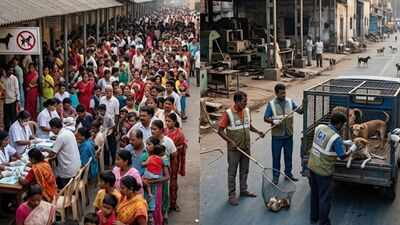
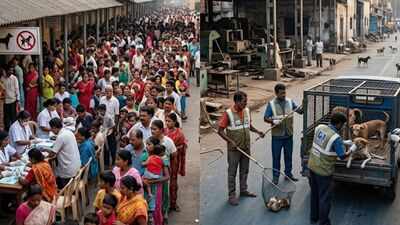
The canine vaccination drive has also lost considerable momentum. KMC had vaccinated 15,296 dogs by Dec 14, 2024, against 13,711 in 2023. More than 34,000 bite patients, meanwhile, required vaccination in 2023, while another 34,430 were treated between Jan and Nov 2024.Civic officials conceded that inadequate infrastructure and manpower have crippled attempts to vaccinate and sterilise Kolkata’s estimated 84,000 street dogs.KMC-run Dhapa dog pound — the city’s only govt facility where street dogs are kept for sterilisation, vaccination and treatment — can accommodate only around 250 animals at a time. Of 19 sanctioned dog-catcher posts, only nine are presently available, while three of the civic body’s six catching vans are reportedly out of operation because of technical problems.“It is an uphill task to catch strays from public places across 144 wards with only nine dog catchers. Insufficient dog-catching vans is another issue,” a KMC official said.The limitations have also complicated efforts to deal with stray dogs around hospitals, schools, railway stations, bus terminals and govt offices.KMC had launched a special time-bound vaccination and sterilisation programme in March 2022, with the aim of vaccinating the entire estimated street-dog population and sterilising about 60% of it. The state sanctioned Rs 88 lakh for the programme and Centre Rs 14 lakh, with an initial one-year deadline.Civic officials, however, said the project subsequently ran into infrastructure and manpower shortages, inadequate pound capacity, waterlogging at Dhapa and mismatches in borough-wise dog-population records.A ward-wise assessment remains another major missing link. In an RTI response in Aug 2025, KMC said it was “presently not in a position” to provide ward-wise figures for vaccination and sterilisation, making it difficult to identify bite hotspots and assess whether canine vaccination is being concentrated where risks are highest.WHO considers sustained vaccination of around 70% of the dog population critical to interrupting dog-mediated rabies transmission.