



Kolkata: Bengal’s stringent, new anti-gang law made its debut on Saturday, with the administration using it to register seven FIRs at Hare Street and Entally Police Stations as it doubled down on Friday’s protest march in the city against the Centre for repeated paper leaks and other grievances.Seventy people — none of them students — had been identified in connection with Friday’s violence, CM Suvendu Adhikari said in the assembly on Friday and proceeded to name five of them: “They will get such severe punishment that their next three generations will remember it.”The Kolkata leg of Friday’s nationwide students’ protest saw a march that went on for about 90 minutes and covered around 3 km between Sealdah and Esplanade, bringing the city centre to a halt for over five hours.
CJP Jantar Mantar Protest Updates
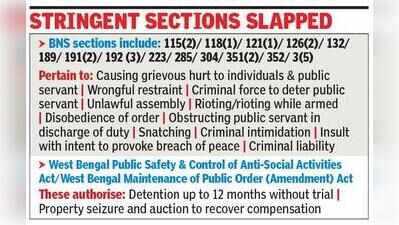
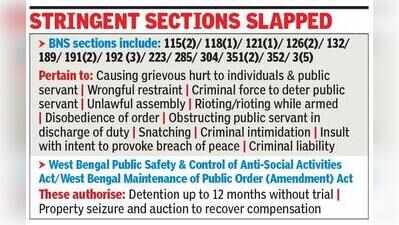
The march — peaceful to start with — ended in a clash with cops at Dorina Crossing, with protesters hurling stones, sticks, shoes and water bottles at police personnel, journalists and passersby. Cops, who acted with restraint, later said six journalists were among those assaulted.Adhikari on Friday said anti-social elements had infiltrated the march and provoked cops to trigger a law-and-order situation. “The administration had issued clear instructions that police should not use force or take coercive action unless the assembled protesters or marchers went completely out of control. The marchers targeted journalists because, despite repeated attempts, they failed to lure the police into their trap,” Adhikari said, adding: “They wanted cops to resort to baton charges, fire tear-gas shells and use force so that they could escalate the drama. The police did not give them that opportunity.”Miscreants were hired from Kidderpore, Rajabazar, Park Circus, Akra, Belgachhia, Rajarhat-New Town, Baguiati and other areas, Adhikari said, naming five of them with “criminal antecedents”: Afroz from Rajabazar, Nahid from Kidderpore, Tanvir and Nizam from Ekbalpore and Rahul Jamal from Watgunge.“I have announced the names of these five goons. The anti-gang law contains provisions that will ensure these criminals — and three generations of their families — remember its consequences. This is precisely why we introduced the anti-gang law. The people of Bengal have now seen how necessary this legislation was,” he said.The assembly on June 29 passed the West Bengal Public Safety and Control of Anti-Social Activities Bill, 2026, and the West Bengal Maintenance of Public Order (Amendment) Bill, 2026. They allow preventive detention for up to 12 months without trial and provide for recovery of compensation for damage to public property.Adhikari, who visited the injured journalists in hospital on Friday, said he was personally monitoring their condition. He later led other BJP MLAs in condemning the attack. “The injured journalists are Dipankar Dasgupta, Makhan Patra, Suman Mahapatra, Rik Purkayastha, Shiladitya Kar and Krishnendu Majumdar. We have already received written complaints from their colleagues,” he said. “If throwing eggs is not part of Bengal’s culture, then throwing bottles and shoes at journalists cannot be considered part of Bengal’s culture either,” he reasoned.Adhikari targeted the organisers of the march, led by Debadip Ganguly of the Cockroach Janata Party and supported by several leftist organisations, including frontal organisations of CPM and SUCI, and blamed them for provoking the protesters.“We have seen on social media how people were told cops would be ready with tear-gas shells and all protesters should carry a bottle of water,” he added.The seven FIRs invoked multiple provisions of the Bharatiya Nyaya Sanhita (BNS) and were registered after a suo motu complaint by sub-inspector Dinabandhu Kesh of Hare Street PS.