








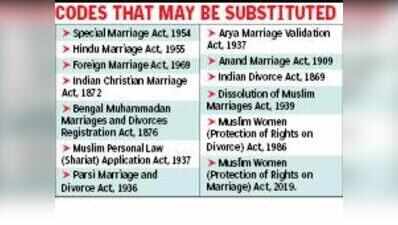
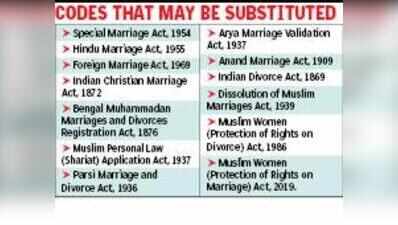
Kolkata: At least 13 marriage acts are likely to be replaced by a single law focusing on gender equality and religion-neutrality under Bengal’s proposed Uniform Civil Code (UCC).The UCC, being drafted by a committee which will hold its first meeting in Delhi on Thursday, will replace religion-specific personal laws with a unified legal framework governing marriage, divorce, maintenance, succession and guardianship across all communities. Scheduled Tribes will remain outside the code’s ambit.A source said, “At least 13 marriage acts (see graphic) will be revoked under the proposed UCC and replaced by a single act. The primary emphasis will be on gender equality, followed by religion-neutrality. The new act will not interfere with cultural practices, attire or traditional rituals.”The 13 acts likely to be replaced are Indian Divorce Act, 1869; Indian Christian Marriage Act, 1872; Bengal Muhammadan Marriages and Divorces Registration Act, 1876; Anand Marriage Act, 1909; Parsi Marriage and Divorce Act, 1936; Arya Marriage Validation Act, 1937; Muslim Personal Law (Shariat) Application Act, 1937; Dissolution of Muslim Marriages Act, 1939; Special Marriage Act, 1954; Hindu Marriage Act, 1955; Foreign Marriage Act, 1969; Muslim Women (Protection of Rights on Divorce) Act, 1986; and Muslim Women (Protection of Rights on Marriage) Act, 2019.The acts, applied on the basis of faith, interfaith status and overseas location, govern matrimonial rites, civil unions and divorces.Under the proposed UCC, all marriages must be registered with designated state authorities within a specified deadline.There will be no out-of-court divorces. Grounds for divorce will be identical for both partners and the spouses will have equal rights regarding maintenance and alimony. Traditional practices of separation, such as Nikah halala, will be abolished,” the source said.The proposed code mandates live-in partners to register their partnership, failing which they will face penalties. “This will prevent fraud and also ensure legal protection for both partners as well as children born out of live-in relationships,” the source said. “There will be no provision for polygamy or bigamy under the Bengal UCC. Child marriage will be banned regardless of religion.”In matters of succession, sons and daughters will enjoy equal rights to ancestral property. Adoption and testamentary wills, too, will be religion-neutral and gender-equal.Osman Mallick, a lawyer and member of the committee drafting the UCC, said, “The panel will have its first meeting in Delhi tomorrow to formulate a comprehensive roadmap for the Bengal UCC. Currently, we are finalising preliminary administrative work.”