








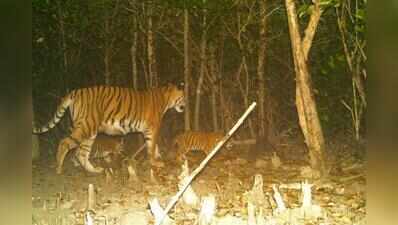
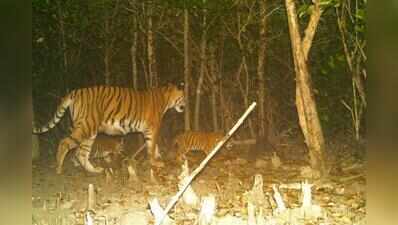
Kolkata: The latest camera-trap survey in the Sundarbans has offered an encouraging sign for tiger conservation, with the Bengal forest dept recording images of at least 12 female tigers with cubs and sub-adults. The sightings, as per officials, have raised hopes that the mangrove landscape could see a rise of 8-12 tigers in the next official population estimate — to be released next year — subject to the criteria adopted during the All-India Tiger Estimation (AITE) on counting of individuals.The camera-trap exercise, held between Nov 2025 and first week of Feb 2026, covered both Sundarbans Tiger Reserve and South 24 Parganas forest division. Around 1,400 cameras were deployed across the landscape, generating thousands of images.Ahead of Global Tiger Day on Wednesday, the dept shared a few photographs with TOI, highlighting what officials described as evidence of a stable tiger population and a healthy mangrove ecosystem. One of the notable images also captured a fishing cat carrying a fish larger than its body, underscoring the richness of the biodiversity.According to the 2022 AITE, the Sundarbans is home to 101 tigers. Officials believe the latest evidence of breeding tigers could improve those numbers if the cubs and sub-adults meet the eligibility criteria for inclusion in the national census.Former Wildlife Institute of India senior scientist Qamar Qureshi, who co-authored the 2022 All-India Tiger Estimation report, explained that tigers older than one year — especially those nearing two years of age — are close to the mother’s size and can also be seen moving independently in photos. They have a lower mortality risk, too. Such animals are generally considered individual tigers.However, Qureshi cautioned that the Sundarbans has already reached its ecological carrying capacity — the maximum number of tigers the habitat can sustainably support based on prey, water and available territory. Unlike other tiger landscapes, relocating animals in or out of Sundarbans is not possible due to its unique habitat shared with Bangladesh. “Addition or deletion of 4-5 individuals is not a big deal. In Sundarbans, the figures are structured around the same estimate that we have been getting in the past few cycles. So, it’s already operating in its carrying capacity,” he added. Another expert said opening a dialogue with Bangladesh on movement of big cats between India and Bangladesh Sundarbans can be explored. “There should be free movement of tigers between the landscapes. But, there’s a plan to fence about 90 km of the Sundarbans along the India-Bangladesh border in Bengal to strengthen border security. This may not be good for tiger conservation in the long run,” he added.The ongoing AITE analysis for the Sundarbans is yet to begin, with NTCA officials indicating that preliminary findings from the nationwide exercise are expected only next year. On Wednesday, a report on status of sloth bears in tiger reserves will be released by the NTCA in Delhi.