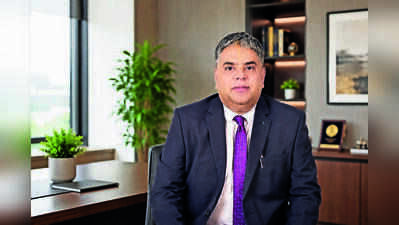










Chennai: Japanese 2W maker Yamaha’s all-new YZF-R2 motorcycle, its first offering in the 200cc segment in India, made its global debut here on Thursday in the presence of Motofumi Shitara, president, CEO and representative director of Yamaha Motor Co. The company seeks to consolidate its position in the above-150cc segment in India. Shitara spoke to TOI about the company’s future strategy for India. Edited excerpts:Is India primarily a sales market, an export base, an engineering hub, or are all these elements important to Yamaha’s India strategy?I first came to India in 2018, and that gives me a useful vantage point from which to compare the country then with what I see today—and how Yamaha plans to position itself for the future. India has evolved into one of the world’s fastest-growing major economies, attracting investment across infrastructure, healthcare, automobiles, agriculture and IT. Rising incomes are also changing consumer behaviour: motorcycles are increasingly becoming lifestyle and premium products rather than simply a means of transport. Yamaha anticipated this shift when I took charge of India operations in 2018 and began focusing on premium motorcycles, backed by technology, production changes and stronger branding. Since then, average wholesale selling prices and revenue have doubled, the premium product share has more than tripled, and operating profit has risen 30-fold. India, however, still offers significant room for further growth.Global supply chains continue to face geopolitical challenges. Do you see India helping the company build a more resilient supply chain?From a supply-chain perspective, China, the US and India are the three major markets. But the US and China face greater geopolitical risks—from tariffs, export controls on rare earths and tensions in West Asia. India appears relatively less exposed, creating an opportunity to strengthen its role in global supply chains. Rare earths are critical to both ICE vehicles and EVs, including catalysts and semiconductor components, making secure procurement increasingly important. The focus, therefore, is on integrating India more deeply into global supply chains to ensure stable and flexible sourcing. Yamaha, like other global companies, is closely watching India from this perspective.Are there any adjacent business opportunities or new segments that Yamaha is evaluating to strengthen its presence in India?Yamaha sees significant potential in several new business areas in India, including robotics, semiconductor-related equipment and factory automation. The company has already begun building a robotics business base in Gurugram, Haryana, with a new facility now operational. It is also exploring opportunities in Surface Mount Technology (SMT) for semiconductors, factory automation equipment, particularly industrial robots, and semiconductor backend equipment, including AI-enabled solutions. Yamaha is exploring two ways to expand the business in India: setting up a local manufacturing base or partnering with an Indian company to import and sell products. I also believe India can serve not only as a centre for technological development and production, but also as an important test market for our products. Over time, India could evolve into a global hub for developing and testing new products for global requirements.How is Yamaha balancing its investments between electric mobility and ICE technologies for the Indian market?On electric mobility, Yamaha is taking a measured approach. Several factors are important in this space. The pace of adoption depends on practical considerations such as charging time, range, charging infrastructure, affordability and government support. Of course, keeping in view that we have already made preparations to add electric mobility to our product portfolio, we will continue to strengthen our products in both the electric and premium ICE segments.How do you see India’s latest FTAs shaping Yamaha’s future decisions on products, manufacturing, supply chains and investments?When a country signs FTAs with different countries or regions, it improves its economic positioning and strengthens its ability to participate in global trade. That can be said without a doubt. However, an FTA by itself is never sufficient. We feel that India, economically speaking, has already been growing in prominence and influence. To top that, we have the FTAs as well. Obviously, all of this means that it is going to become easier to trade, and trade will be facilitated both within India and with other markets.