












BY-Rachel erghese& Meghna RewachandMUMBAI: The Central Board of Secondary Education (CBSE) on Wednesday declared the Class 10 results for 2026, marking a pivotal shift in India’s assessment landscape with the debut of the dual board examination policy. While the national pass percentage saw a marginal increase to 93.7% from 93.66% last year, the results were shaped by a significant surge in high-percentile scorers and a challenging mathematics paper that tested the board’s move towards application-based evaluation.Under the new policy introduced this year, students were given their first opportunity to sit for boards in a two-round system. Those seeking a “betterment” of marks in up to three subjects can now appear for a second round of exams scheduled for May. This shift aims to reduce high-stakes pressure of a single year-end window.
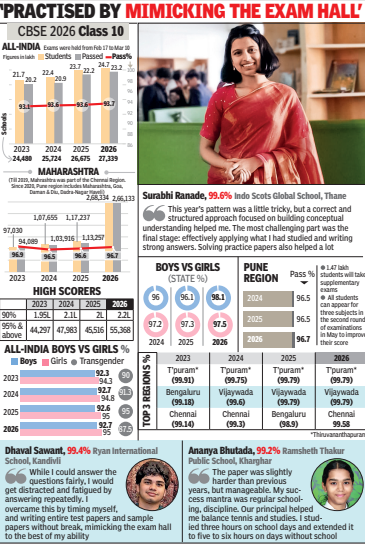
In the Pune region, which includes Maharashtra, Goa, and Daman and Diu, the pass percentage stood at 96.66%. Of the 1,33,382 candidates who appeared from the region, 1,28,933 qualified. Nationally, Thiruvananthapuram and Vijayawada shared the top spot with a 99.79% success rate, followed by Chennai at 99.58%.The 2026 results highlighted a move away from rote memorisation and towards application-based testing. Unlike traditional exams that ask for direct definitions or theory, this format requires students to apply theoretical concepts to real-world scenarios or unfamiliar problems. This approach evaluates critical thinking and deep comprehension rather than the ability to recall textbook passages.While linguistic subjects helped students secure high aggregates, mathematics emerged as a hurdle. Educators noted that a high-difficulty five-mark question, requiring complex problem-solving rather than standard formulaic application, impacted final scores. “Languages led the scorecard, with an exceptional showing. We have 19 perfect scores in English and nine in French,” said R N Podar’s principal-director Avnita Bir. She added that mathematics was a “weak spot”, noting no clear evidence of moderation to offset the difficulty, though sustained support ensured a 100% pass result for the cohort, including students with learning disabilities.Kalpana Dwivedi, principal of Bal Bharati Public School, Kharghar, said the math paper dragged down aggregates as students found it “lengthy and more application-based”. Conversely, high-scorers such as Manvik Kashyap of Apeejay School, Nerul, who secured 98.8%, described the shift as “interesting”, noting that the papers encouraged practical thinking over theory, particularly in social science.The number of high-achievers was significantly higher, with 2,21,574 students scoring 90% and above, up 4.3% compared with 2,12,384 in 2025. An even sharper rise was recorded in the 95% and above category, which saw 55,368 students qualify this year compared to 47,983 in 2025-up 15.4% jump.Girls continued to outperform boys, recording a pass percentage of 94.99% against 92.69%. Transgender students recorded a pass rate of 87.5%.A total of 1,47,172 students (5.95%) were placed in the compartment category. Students can now apply for the upcoming second round of the exams.