










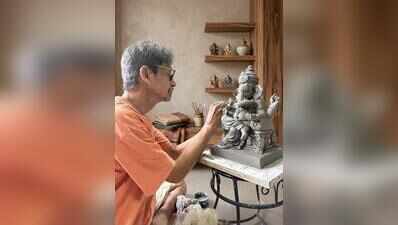
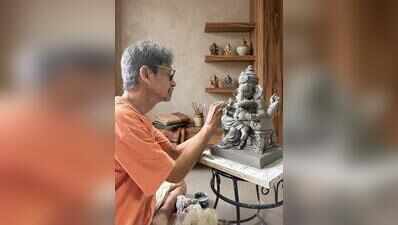
Mumbai: In a workshop at King Circle, a towering Ganesh idol is slowly taking shape, not from Plaster of Paris (PoP), but from shadu clay, sculpted patiently by hand. For years, commercial idol-makers have been arguing that giant public idols cannot be made from clay, claiming the material is too fragile to support its own weight. At GSB Seva Mandal, that assumption quietly falls apart: artisans here have been hand-crafting massive clay idols for over seven decades.Outside its walls, however, PoP continues to dominate Mumbai’s workshops. And as Bombay high court once again hears the state govt’s plea to extend the use of PoP idols taller than six feet for immersion in natural water bodies, the city’s familiar annual environmental debate has returned. Court directions on phasing out PoP date back to 2013, but artisans, environmentalists and organisers say the transition is shaped by far more than the choice of material.Marine biologist Yazad Mehta (30) is clear about the environmental cost. Contrary to popular belief, he says, PoP idols do not dissolve after immersion. Their calcium sulphate base breaks down into dense, non-biodegradable sludge that settles across the seabed. “Along with PoP, it’s also the heavy metal paints on these idols that severely pollute our water bodies,” Mehta says, adding, “synthetic paints laden with toxic heavy metals leach persistent chemicals into the marine ecosystem.”Artisans, though, often start the discussion elsewhere: with engineering. At GSB Seva Mandal, trustee RG Bhat says their idol has always been made differently. “Our idol is made with clay only, pure shadu mati,” he says, adding that its dimensions are determined by tradition as much as craftsmanship. Every year, the deity is adorned with more than 65 kg of gold and hundreds of kg of silver jewellery. “Because it has jewellery, all its measurements need to be exact; otherwise it doesn’t fit,” says Avinash Patkar (67), a former JJ School of Art professor and second-generation sculptor behind the idol.Working alongside his daughter Gautami Patkar (35), who has been experimenting with large-scale papier-mâché idols, Patkar spends nearly a month sculpting the idol by hand. Raw clay is mixed with sacred durva grass and dried hay to create a fibrous material that binds naturally without a rigid mould. The idol then dries under industrial exhaust fans for nearly a week before hairline cracks are repaired with fresh clay. “A person doing PoP work cannot even apply it,” Patkar says, pointing to the specialised skill shadu clay demands.Many commercial workshops across Mumbai, though, say the real challenge is less about technique than time and space. PoP cures within hours and dries completely in two to three days; shadu clay can take between 15 and 20 days to dry in Mumbai’s monsoon humidity. Artisans say that difference affects almost every stage of production. A single clay idol often needs to be shifted, rotated and supported between 25 and 40 times as it dries, requiring considerably more workshop space in a city where land is at a premium.Prakash Koyande (54), a spray-paint and detailing specialist in Jogeshwari with 27 years in the trade, says workspace has become his biggest concern. “This year, I don’t have a pandal. The space that I had was through BMC, and it hasn’t been allotted to me this year due to space issues. If I leave one place and go to another, it affects the customers, and I have to look out for my artisans too,” he says. Access to workspace remains a challenge, Koyande says, even as BMC provides free shadu clay through its online single-window system.The economics also shape material choices. Ramchandra Patil of Majha Morya in Navi Mumbai, who has sold PoP, shadu clay, red soil and paper idols since 2017, says customers transporting idols over long distances usually prefer PoP for its durability.Dattadri Kothur (40), art director and founder of Tree Ganesha in Worli, says the difference begins inside the workshop. “PoP makers have more demand and earn more because they get paid per piece,” he says. A worker pouring liquefied plaster into a rubber mould can produce about ten identical idols a day and earn roughly Rs 1,000, Kothur says; a clay artisan may spend the same amount of time shaping and reinforcing a single idol while earning about Rs 500. Those differences show up in retail prices too: mass-produced PoP idols are often available at nearly half the price of comparable clay idols. Clay idols also require customised wooden support frames for transport, adding further to production and logistics costs.Kothur has taken a different approach in his own workshop. Tree Ganesha makes idols from untreated red soil sourced from Gujarat and the Konkan, avoids chemical paints, and embeds each idol with seeds and fertilisers so devotees can immerse them at home in supplied pots. Even then, he says, convincing first-time buyers isn’t easy. “First-time users always ask if it will break during transport,” he says, a hesitation he believes is rooted in faith as much as practicality. “People hold a deep devotion; they fear that if an idol cracks at home during drying or transit, it brings a bad omen.”Municipal data shows Mumbai deployed 298 artificial immersion sites in 2025, with 98% of smaller household idols immersed there. Yet 61% of all idols immersed that year were still made of PoP.Kothur believes the transition to eco-friendly idols will depend as much on public leadership as on policy. “If the mega mandals, the celebrities, and the historic icons like Lalbaugcha Raja lead by example, by voluntarily reducing their height and embracing clay, 100 other neighbourhood mandals will instantly follow,” he says. Until the leadership of the festival changes its definition of grandeur, the artisans on the margins will continue to fight an uphill battle against time, space, and the rigid mould of plaster.