




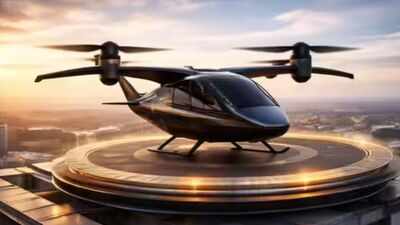
MUMBAI: For five years, it existed largely as equations, computational models and a series of progressively larger flying demonstrators. On Monday, it finally took the shape of a full-sized aircraft. Chennai-based deep-tech startup The ePlane Company announced that it has unveiled PT-01, the first full-scale prototype of its electric vertical take-off and landing (eVTOL) aircraft. The unveiling at the company’s new 60,000 sq ft production facility on the IIT Madras Discovery Campus marks an important milestone in India’s attempt to build an entirely new category of aircraft. The prototype of the e200X, designated PT-01, will not carry a pilot during its earliest test flights.More than just another flying taxiElectric vertical take-off and landing aircraft, better known as eVTOLs, are frequently described as flying taxis, a label that is catchy but simplistic.Unlike conventional aircraft that require runways, an eVTOL rises vertically like a helicopter before transitioning into wing-borne forward flight. Electric motors replace turbine engines, making the aircraft quieter, mechanically simpler and potentially cheaper to operate. The aircraft solves the problem of road traffic congestion by introducing an entirely new layer of urban transport, one that connects hospitals, airports and city centres by air without the cost and complexity of helicopters.The idea has attracted billions of dollars in investment over the past decade. Companies such as Joby Aviation, Archer Aviation and Beta Technologies in the United States, Vertical Aerospace in the UK, and EHang and AutoFlight in China have all been racing towards commercial certification. But the industry’s biggest lesson has been that building a prototype is only the beginning. Media reports show that certification has repeatedly taken longer than expected, regulators have adopted a cautious approach to a completely new class of aircraft, and several companies have had to push back ambitious commercial timelines. It is against this backdrop that ePlane’s announcement of unveiling of a full scale prototype assumes significance as with it India enters the same phase that many global players are navigating, which is, not proving the concept, but proving its safety.Designing the aircraft around the cityThe image of the aircraft put up on the company website shows a compact, fixed-wing aircraft with multiple electric propellers, built entirely from carbon-fibre composites. It weighs about 2.2 tonnes, has a wingspan of eight metres and an operational range of around 110 km, said the company in a press statement issued on Monday. What range means is that in a single charge the ePlane could theoretically connect Mumbai and Pune, Chennai and Puducherry, or Bengaluru airport with technology parks on the city’s outskirts. More importantly, it could transport a critically ill patient between hospitals in a fraction of the time taken by road during peak traffic.The company said the first commercial application will likely be air ambulances before expanding into passenger services. The more crucial note here is that India’s eVTOL sees itself fitting into the existing aviation infrastructure. “An aircraft that demands a city rebuild its entire skyline around it is a failure of engineering, not a triumph,” said said IIT Madras professor, Satya Chakravarthy, the founder and technical lead of The ePlane company, in an online interaction with TOI. The remark captures the thinking behind the aircraft.Many eVTOL developers have designed aircraft first and assumed cities would eventually build specialised vertiports and new infrastructure around them. Chakravarthy believes the process should work in reverse. “The market should shape the aircraft, not the other way around,” he said. The result is a relatively compact aircraft with a footprint of roughly eight by eleven metres, allowing it to take off and land from spaces about half the size of a basketball court. The compactness would allow many existing hospital helipads and rooftops to be used without extensive new infrastructure, the company said. Hospitals already possess helipads, emergency patients value time above ticket prices, and air ambulances typically operate fixed routes rather than requiring an extensive network of urban landing sites.Why the first flights will have no pilot“The PT-01 is an experimental prototype, its unmanned and that is typically how any eVTOL company starts with, you don’t want to risk putting a human being right in their first prototype itself,” said Chakravarthy. Modern fly-by-wire systems have become mature enough to safely conduct initial testing without placing a pilot onboard, he said. “Today unmanned flights are doable, it’s not like the golden days when people had to actually be in the cockpit and wield the stick in order to be able to fly,” he said. The decision is not driven by regulation. It is driven by engineering philosophy. The company said it wants to demonstrate that the aircraft can safely cope with the failure of one propulsion unit before asking anyone to sit inside it. “This is my conviction as a founder,” Chakravarthy said. “Before I put a human being into the aircraft, let’s actually prove it.” That capability, known as a single-engine failure mode, is not necessarily mandatory for this class of aircraft before piloted flights begin. But Chakravarthy said he believes urban air mobility demands higher levels of redundancy than the minimum required by regulation. Ground testing is expected to begin early next year, followed by critical design reviews and regulatory approvals before certification-compliant flight testing begins around the second quarter of 2027. Commercial certification is expected to take another two to three years after that, although company executives acknowledge that aviation programmes rarely follow precise calendars. Internally, board member and former IndiGo president Aditya Ghosh describes it differently. “We’re now in the thousand-day zone,” he said.The Airline Veteran’s BetIf Chakravarthy provides the engineering vision, Aditya Ghosh brings the perspective of someone who has spent two decades building and running an airline. The former IndiGo president, who now serves on ePlane’s board, said he was drawn not by the novelty of electric flight but by the problem it seeks to solve. “I’ve spent most of my life around civil aviation,” Ghosh said. “Urban mobility is a real problem, not just in India but across the world.” What convinced him was a combination of factors: an engineering team rooted in aerospace rather than software, a product aimed at solving a genuine transportation problem, growing policy support and the emergence of investors willing to back deep-technology ventures. “This is not a new ice cream brand,” he said. “This is actually solving a fundamental need for human beings.“For Ghosh, the attraction also lay in the founder himself. “Here is someone with core domain knowledge,” he said of Chakravarthy. “Someone saying, ‘I’m going to give up my IIT professor academic career and put my money where my mouth is.'” Ghosh’s arrival also marked a perceptible shift in how the company is perceived. Without his name behind the project, the ePlane would have been largely viewed as an IIT Madras research spin-off exploring an emerging technology, like many other projects of the kind. Bringing in a former airline chief executive changed the conversation from whether the aircraft could be built to whether it could eventually become a commercially viable aviation business. The unveiling of the prototype also reflects growing confidence that India may be building the regulatory framework needed for urban air mobility faster than many realise. “The DGCA is actually ahead of the game,” Ghosh said. Building redundancy into the aircraftAircraft certification is, in many ways, the science of imagining everything that could go wrong. The ePlane company said it believes its design differs from several competitors. Many lift-plus-cruise eVTOLs use four vertical lift rotors and a single propeller for forward flight. Lose one lift rotor and the aircraft immediately becomes harder to control. Lose the sole cruise propeller and forward flight ends altogether. The e200X instead uses six independent lift rotors and four forward propellers. “If one of them fails, the remaining five can redistribute thrust,” Chakravarthy explained. “If one forward propeller fails, the remaining three continue.” The distributed electric propulsion system eliminates what engineers call single-point failures, a characteristic the company believes is particularly important for aircraft expected to operate over cities. Then there is its patented “Synergistic Lift” technology.Rather than relying on tilt rotors that rotate between vertical and horizontal flight, the aircraft combines fixed wings with separate lift and cruise propellers. The patent covers the relationship between the wing and the vertical rotors, producing more lift together than would be generated by each independently, he said adding that the particular combination allows the aircraft to produce larger lift than the individual sum.Every kilogram countsThe e200X is designed to carry a pilot plus a 200-kg payload. During the interaction, Chakravarthy clarified that the pilot’s weight is excluded from that figure. For passenger operations, the aircraft has been designed around higher assumed passenger weights than the regulatory minimum, leaving enough margin for luggage. In the ambulance version, the payload accommodates a patient, paramedic and emergency medical equipment including oxygen cylinders.A marathon, not a sprintThe ePlane Company has raised $21.5 million from investors including Speciale Invest, Antares Ventures, Micelio Mobility and several angel investors. The company said it has received commitments for more than 800 aircraft, with much of the early interest coming from emergency medical services.Whether the e200X ultimately transforms urban transport remains an open question. Around the world, dozens of companies are still trying to answer it. But one thing has become clear. For five years, the challenge was building an aircraft. The next thousand days will determine whether India can build something even harder: confidence that an entirely new way of flying belongs in everyday aviation.