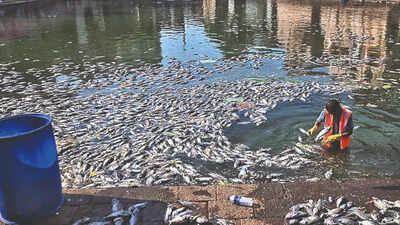
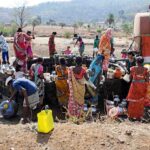



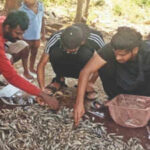




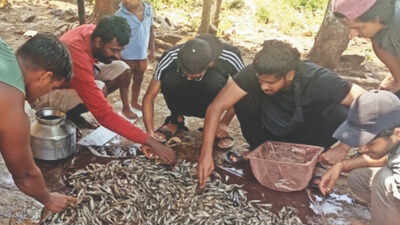
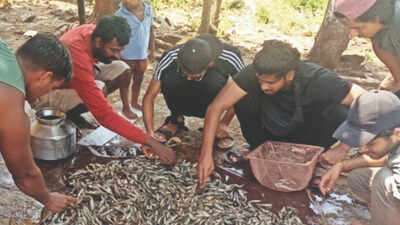
MUMBAI: The sun rose on the Kalu as it did every other day. But on Sunday, along with it rose fish – hundreds, stippling the waters in grisly pointillism. Avinash Harad, an environmental activist who had led a group of six researchers on a biodiversity survey to a site on the river – the ferry crossing at Atali and Nandkar, villages on either side of the Kalu – said hundreds of fish had floated to the surface, dead or dying.“The fish died because of untreated effluents from upstream dyeing units in Ulhasnagar that flowed into the Kalu at high tide,” Harad said.He said the sluice gates of the KT Dam in Titwala are opened during the rains, bringing a surge of water during high tide that conveys factory discharge downstream. “The fish – mostly catfish and tilapia – died along at least 1 km of the Kalu, just before it meets the Ulhas river.”On Sunday morning, Khandu Koli, a fisherman from Nandkar Koliwada in Bhiwandi taluka, was out on the river with 35-40 fishers from Atali and Nandkar, scooping fish out in handheld nets. Koli, whose own family netted 55 kg, said the phenomenon is not uncommon. “But we don’t fish when the water turns black,” he said.The catch was sold, with a small portion reserved for the fishers’ own consumption.Jehu Nadar, a zoologist in the survey group, said prawns had surfaced alongside the fish. Both were dead by 10am.Nadar said the waters were dark green. The team collected samples and found many parameters off the charts: total dissolved solids (TDS) at Atali measured 210 parts per million (ppm), dissolved oxygen (DO) fell to 1.28 mg/L – far below the optimal 6-8 mg/L that aquatic life needs to survive. Upstream at Gurawali Bridge in Titwala , by contrast, TDS was 95.2 ppm and DO 5.53 mg/L.“Mystus catfish can tolerate very poor water quality, and tilapia are notoriously tough. If they are turning up dead, the water has reached an absolute zero-survival threshold,” Nadar said.The friend of a local fisher who accompanied the group forewarned them of the die-off on Saturday. “He got wind that effluents had been discharged upstream,” Nadar said. It was only a matter of time before they surfaced here.