








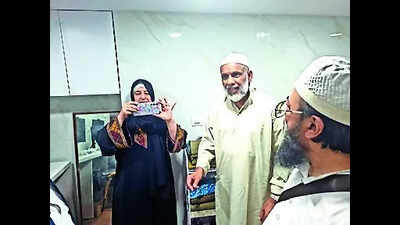
MUMBAI: Many men at the packed hall in Mira Road heard Indian-British Islamic scholar Mohammad Akram Nadwi with amazement. Citing instances from early Islam, Nadwi said that stopping women from visiting mosques and offering namaz there is against Prophet Muhammad’s traditions.Contrary to what the Prophet and many of his companions did, most mosques in the Indian subcontinent do not encourage women to worship there. And Nadwi is on a mission to remove this barrier created as an unwritten moral code.Former research fellow at the Oxford Centre for Islamic Studies, author and commentator, Nadwi, 65, was in the city this past week to speak at a couple of venues, including Anjuman-i-Islam’s Saboo Siddik Engineering College in Byculla and a civic hall in Mira Road. “The Prophet would plan and discuss a lot of things. He would speak directly to women and women would ask him questions,” said Nadwi. “If women in early Islam could participate in battles, why would they be prevented from joining men in prayers?”Hailing from Jaunpur (UP) and educated at the famous madrassa Nadwatul Ulema in Lucknow, Nadwi went to Oxford for higher studies. His research concerns a fascinating subject: women narrators of Hadiths or sayings/traditions of the Prophet.For the uninitiated, the Quran or the book carrying divine verses revealed on Prophet Muhammad and the latter’s hadiths or sayings form the core of Islam. There are many narrators, both men and women, of the hadiths. Nadwi focused on Muhadditha or women narrators of the hadiths. He has earned acclaim for his research, which resulted in details about over 10,000 women narrators of hadiths in 43 volumes.His seminal work has earned him wide acclaim. Uzma Naheed, founder-director of NGO Iqra Integral Women’s Alliance (IIWA), who facilitated Nadwi’s talks in the city, called him “a leading scholar of contemporary Islam.” “His work is immensely significant. When Muslim Ulema established madrassas in the post-1857 holocaust in India, their primary concern was to educate Muslim males. Somehow, the females were left in the lurch in the hope that educated men would teach Islam to their women. Women remained mostly confined to their homes and even when they got educated, their presence in the mosques was not appreciated,” said Naheed. “Thanks to the efforts of scholars like Akram Nadwi, now many mosques are opening their doors to women too.”