








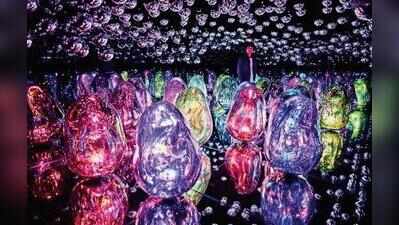
Outside, Mumbai’s monsoon is doing what it does best… turning the city into an immersive installation of its own. Inside somewhere, visitors wander through forests of digital flowers, chase bubbles that pop into light, and find their own shadows swallowed and multiplied by the walls around them.That’s the world of Second Nature, an immersive showcase making its India debut across all four floors of NMACC’s Art House. Created by Superblue — the Miami-based enterprise behind some of the world’s best-known experiential art projects — the six-month exhibition belongs to a growing genre of art you can walk into, rather than admire it from behind a rope.For Mollie Dent-Brocklehurst, co-founder of Superblue, that switch from spectator to participant is what matters. Long before immersive art became one of the biggest draws for museums around the world, the British curator had already spotted its potential after having spent decades moving through the upper echelons of the art world.She helped establish Gagosian’s first London gallery, brought international contemporary art to Moscow through Garage, curated sculpture exhibitions in the grounds of her family’s Sudeley Castle, and later built a partnership between the urban design firm Futurecity and Pace Gallery to commission site-specific work beyond gallery walls.At every stage of her career, Dent-Brocklehurst questioned where art should live, and along the way kept running into the same problem. “Some of the most ambitious contemporary artists didn’t fit that well into the gallery system… paintings and sculptures or into this kind of rather pervasive art fair world,” she says. Museums, meanwhile, typically rotated exhibitions every few months, while large-scale installations took weeks to build and far longer runs to justify the cost.So when she co-founded Superblue in 2019, she built a new model that commissions large-scale experiential works, pays artists upfront, and shares ticket revenue with them, instead of relying on collectors or institutions to buy objects. She compares it to another creative industry that stopped depending on wealthy patrons. “A bit like the moment where music changed from being something that was commissioned to being bought by the public.”Artists can now create works that were previously commercially unsustainable. It’s also prodded traditional institutions towards embracing artists whose work struggled to fit in. “I’ve been working in the art world all my life, and there were some artists and voices who were saying such extraordinary things but not enough people were hearing it.”Then came a bigger test. Superblue launched on the eve of the pandemic, when gathering strangers in a shared space suddenly seemed unimaginable. Yet, the wager was that people would emerge from lockdown craving shared physical experiences more, not less.That instinct appears to have paid off. Today, experience-led exhibitions have become one of the fastest-growing strands of popular culture, with museums worldwide commissioning walk-through installations that blur the boundaries between art, architecture, theatre, music, digital tech, and who gets to call themselves an artist.The artists behind Second Nature are as likely to work alongside engineers, programmers, architects and musicians as fellow painters. “In my earlier days in the gallery world, there was a sort of cut-off between art and design… fine art and craft,” says Dent-Brocklehurst. “Those definitions have been relaxed. To create these extraordinary experiences, you need multidimensional thinking.”Of course, as the format proliferates, so does criticism. Detractors dismiss it as little more than elaborate selfie backdrops. Margot Mottaz, Superblue’s senior director of exhibitions, doesn’t buy that. “It’s important to create work that people can connect with emotionally the moment they walk in, yet the longer they stay, the more layers they uncover. When immersive art is done well, and you work with great artists, it’s great art. Playfulness and immersion can coexist with meaning,” she says, adding that audiences, too, are becoming more discerning and just slick production is no longer enough.At its heart, it’s about making contemporary art feel less intimidating. “If someone who never visits museums walks into Second Nature and later decides contemporary art is for them, then we’ve done our job,” says Mottaz.