










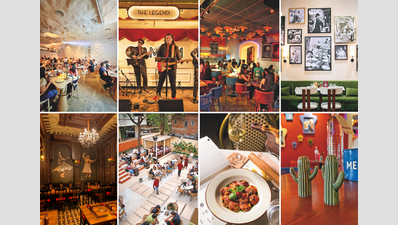
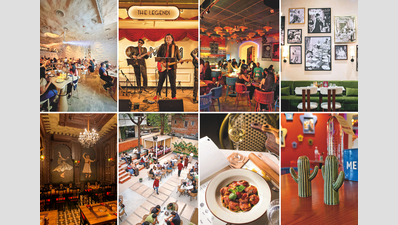
Walk into any well-designed restaurant and something shifts – almost immediately and imperceptibly. The light is just right. The music sits at exactly the right volume. The fork feels satisfying in your hand. But, none of this is coincidence. Long before the first dish arrives, the space has already started shaping your perception. The dining experience, it turns out, is constructed as carefully as the food itself. The plate, the chair, the playlist — none of it is accidental. We spoke to F&B stakeholders who know exactly what makes the diner tick to ensure they come back a second time. The room always speaks first At Fabbrica Originale, co-founder Naman Dhandhania says the intent is baked in from the start. “Our food is rooted in Italian restraint, so the decor, tableware and plating have to be conducive to that language — not overpower it. The aim is to make quality feel immediate, even before the first bite.” Aditya Agarwal of Cove Community Bar takes his cues from wabi-sabi — the Japanese philosophy of beauty in imperfection and simplicity. Earthy tableware, raw textures, a monochromatic palette, all designed to create a sense of authenticity. “When the environment feels grounded and cohesive, it subconsciously elevates how guests perceive both taste and quality,” he says. For interior designer Akash Roy, it always begins with emotion. “It starts with the feeling the space is meant to evoke — everything else follows.” Textures do the heavy lifting: flat surfaces feel monotonous; contrast through rough or tactile finishes adds movement and life. Restaurateur Saket Agarwal says: “At Sorano, softer lighting and more comfortable seating make people want to stay longer, order another course, maybe one more glass of wine. While Mehico, the vibe is more social and upbeat, so you see more groups, more sharing, more drinks. We don’t say it out loud, but the space quietly guides how the evening unfolds.” The weight of a fork Tableware, several restaurateurs agree, is underestimated. “If the cutlery or crockery looks or feels cheap, no amount of lighting or decor can compensate,” says Akash bluntly. Prateek Didwania, of Pico Pizzeria and Coffee Bar and Yours Truly Coffee Roaster, puts it in sensory terms: “A heavier ceramic cup makes the coffee feel more premium. It’s storytelling, not just functionality.” He draws a link between colour and flavour too – pink evokes sweetness, black intensifies the sense of a deeper, darker brew. Aditya agrees. “Guests may not always articulate it, but these details influence their perception of value. When the tactile experience feels refined, they engage more, stay longer, and respond more positively.” Shiladitya Chaudhury is equally deliberate — the choice between metal and porcelain, he says, is always aligned with the brand’s personality. Since his venues are built to scale, every piece must also be durable, replicable, and consistently available. The proof is in Prateek’s cold brew experiment at Pico. The team served it in tall wine glasses – visually striking, but it never quite landed. “It gave diners a fine-dine feel in a café setting,” he says. They switched to 200ml nip bottles poured into short glasses, and the drink became a bestseller overnight. Lighting and seating matters Space design doesn’t just look good — it shapes behaviour. Naman observes that softer lighting and intimate table setups make guests settle in and order more generously. For Aditya, lighting was one of the steepest learning curves. “Once we refined it with more precision, the entire experience improved — from how the food looked to how comfortable guests felt. Lighting is not just an aesthetic tool; it’s a critical part of the dining experience.” Akash takes it further with zoning: quieter corners must coexist with high-energy areas near the bar. Layout, he adds, should guide guests without them realising it. “Staff and guest flow should never clash — that creates chaos and disrupts the experience.” The numbers back it up. Prateek notes that comfortable seating directly increases dwell time and, by extension, the average spend per customer. Larger tables, he adds, tend to generate higher value orders – details that are easy to overlook but hard to argue with. The sound of the room A restaurant’s playlist is as considered as its menu. Paddy Singh Manot, chief vibe officer and music director at AMPM, knows this better than most. When he came onboard, the pub already had a strong visual identity — a bar sitting like a jewel at the centre of the room, an intimate stage, the air of an old-world club. His approach was not to impose a sound, but to listen to what the room was already saying. “I didn’t approach it as ‘what music should I play,’ but rather ‘what is this space already saying, and how do I make the music speak the same language?'” Over time, music and space integrate until they cohere into a single, recognisable identity. Others are equally intentional. Naman treats volume as a calibration tool – too soft and the room falls flat, too loud and it kills conversation. Chaudhury has gone furthest at Choudhury & Co., commissioning 30 exclusive tracks with a music producer, a first, he claims, for a restaurant brand in India. At his other venues the sonic identity is just as distinct: thumris and ghazals at Oudh 1590, old-school country from the 1940s–70s at Chapter 2.What makes an impact
- Heavier cutlery and quality ceramics make food feel more premium
- Soft lighting encourages guests to linger, explore menus, and order more generously.
- Table size influences order value: larger tables tend to produce higher spends.
- Comfortable seating directly correlates with longer stays and higher average spend per customer.
- Music tempo and volume shift ordering patterns — relaxed soundscapes favour food, high-energy settings tilt towards drinks.
- Colour of tableware can alter flavour perception: pink reads as sweet, black as bold and intense.
- A mismatched vessel can undermine even the best product
- Lighting is not decorative — imbalances in tone or intensity affect mood and even how food looks on the plate.
A café needs to be cosy, with softer lights and enough plug points to make it a good co-working space. This makes guests hang out for longer and feel more relaxed – Prateek DidwaniaWhen the glassware feels right, the cutlery has weight, and the plate complements the dish, the food feels more thoughtful. It changes how people receive the dish, how long they spend with it, and even how memorable it feels –Naman DhandhaniaIt’s not about imposing a sound; it’s about discovering and reinforcing what already exists, and then building it patiently, one layer at a time, into something cohesive and lived-in – Pradyumna ‘Paddy’ Singh ManotWhen things become over-designed or overcomplicated, it can make guests uncomfortable. The balance is important. Design should support the experience, not compete with it. The guest should feel like they’re in good hands –Saket Agarwal