






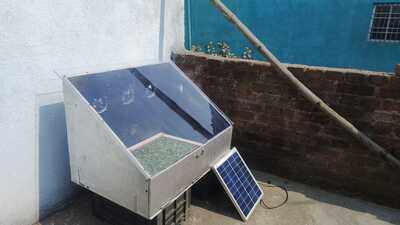
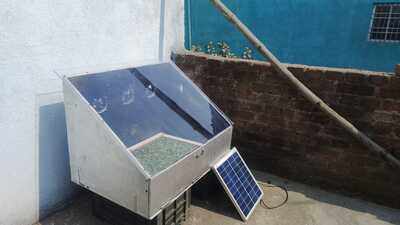
Bokaro: A group of govt school students in Bokaro have developed a solar-powered dryer to help farmers reduce post-harvest losses and improve earnings. Designed as a cleaner and efficient alternative to traditional open drying, the device is showing potential for rural livelihoods.The innovation, built by four students of Plus II Govt High School, Dantu, under Kasmar block, stems from a common issue — spoiling of fruits, vegetables and leaves due to exposure to dust, insects and sudden rainfall during drying in the open.“We saw farmers drying produce on the ground, and sometimes it got spoiled or took too long,” said a team member, Poonam Pal, 17. “That’s when we thought of using solar energy in a safer way.”The team — Pari Kumari (Class XII), Alok Kumar Niranjan (Class XII), Poonam (Class XI) and Bhim Nayak (Class XI) — call themselves ‘Sustainable Warriors’. Guided by their teacher Animesh Chandra, they began work in Dec 2025 and completed the first prototype by April this year. Pari, 17, is daughter of a migrant worker, while Alok, 18, is the son of a barber. Poonam’s father is a security guard and Bhim, 18, is the son of a farmer.Built at a cost of around Rs 11,000 using plywood, glass, fans, solar panels, wiring and switches, the initial manual model has already been upgraded with temperature control features. The team is now working on integrating AI-based automation to enhance efficiency.The dryer has been successfully tested on moringa leaves, neem, ginger, marigold flowers and potato chips — products commonly processed in rural households. It ensures hygienic drying through controlled heat and airflow, powered by solar energy, eliminating dependence on erratic electricity supply.Chandra described the project as a “low-cost, renewable-energy-based intervention” with strong potential for climate-smart agriculture and rural entrepreneurship. Students said the system could particularly benefit self-help groups.“Women in villages already do drying work, but it is unorganised and risky. This can help them turn it into a proper income source,” said Pari.Recently, the team was also honoured with the ‘Eco Innovation Award’ by the Institute of Engineers (India), Bokaro chapter.