







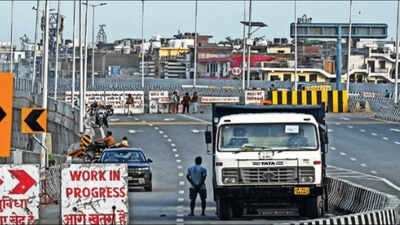
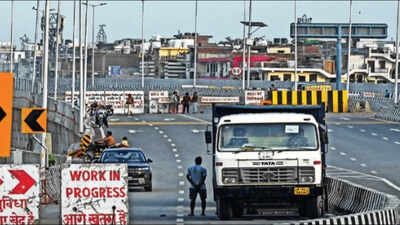
NEW DELHI: As the clock strikes 5.30pm, Sarai Kale Khan slips into gridlock. Already burdened by traffic from multiple sides, the junction is set to bear another surge once the Delhi-Mumbai Expressway is operational.Anticipating the extra load, Delhi Traffic Police has proposed measures to prevent the junction from becoming a congestion and accident hotspotAt the foot overbridge near Sundial Park, all one can see is a river of red and white headlights stretching into the distance.One stream pours in from Ring Road, another crawls down Barapullah, while traffic spills in from Noida, turning the junction into a slow-moving flood.By 6pm, jams on Ring Road stretch up to 2km, while vehicles on Barapullah are often stationary for over half a kilometre.
CJP Jantar Mantar Protest Updates
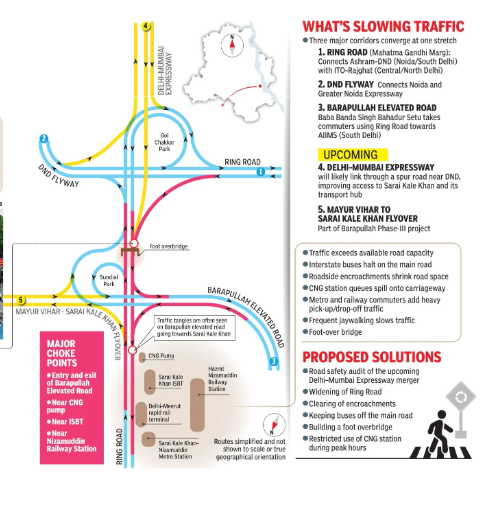
The reason is simple. Sarai Kale Khan is one of Delhi’s busiest convergence points, where traffic from Ring Road, DND flyway, and Barapullah merges.Soon, it will absorb another stream with the opening of the Delhi-Mumbai Expressway, further piling pressure on an already overburdened network.
What’s slowing traffic
According to DCP (Traffic), Southern Range, Sandeep Gupta, unless corrective measures are taken, traffic will outgrow the existing road capacity.“We have identified key bottlenecks and recommended measures like a road safety audit, road widening, encroachment removal, better bus discipline and improved pedestrian infrastructure,” he said.At a recent review meeting, traffic officials cautioned the Delhi-Mumbai Expressway merger could become a major congestion and safety concern.They noted that once the new corridor opens, five lanes of expressway traffic will merge with Ring Road towards Ashram, where high-speed traffic from Sarai Kale Khan already converges.“Immediately after this merging point, the road further splits intotwo major corridors, one leading towards New Friends Colony and the other towards Ashram flyover,” said an official.Police are wary that the convergence of multiple high-speed traffic streams at the complex junction could create an accident black spot.The sudden merging and diverging movements, coupled with heavy traffic volumes, pose a serious risk to commutersThey have, therefore, requested a road safety audit by CSIR-CRRI’s road safety wing or another expert agency before the Delhi-Mumbai Expressway opens.The meeting also highlighted an existing capacity constraint. The stretch of Ring Road between Barapullah and Sarai Kale Khan has only a three-lane carriageway.The traffic police requested PWD to look at the possibility of widening it to four lanes to improve capacity.The congestion is also fuelled by buses and commuter traffic. The ISBT dispatches buses almost every minute, many idling on the roadside, while vehicles skipping the flyover are squeezed into a single lane.By 9pm, queues outside a nearby CNG station spill onto the carriageway, while roadside stalls further eat into road space.Officials have proposed closing the CNG station during peak hours to preventqueues from spilling onto the main road.The Pink Line metro station and Hazrat Nizamuddin railway station bring a steady stream of commuters.Their narrow approach roads quickly clog with erickshaws, autos, taxis and pick-up/dropoff vehicles, sending stop-and-go traffic onto the main carriagewaysA table-top pedestrian has been proposed near the station. Bus operations are another concern.During the meeting, traffic police pointed out that interstate buses often stopon the main carriageway to pick up and drop passengers instead of entering the Sarai Kale Khan ISBT.Police have recommended that DTC direct interstate bus drivers should use the ISBT for boarding and deboarding passengers instead of halting on the main road.Encroachments remain another persistent issue. Sarai Kale Khan is among the 62 identified traffic corridors where roadside encroachments continue to hamper smooth movement.Vendors, dhabas and stalls spill onto the roadside, and motorists often stop for a break, further slowing traffic.Traffic police have requested MCD to remove the encroachments and restore the full carriageway width.Jaywalking has also emerged as a significant safety concern.To reduce pedestrian movement across busy traffic lanes, police have proposed constructing a foot overbridge on Ring Road between Sarai Kale Khan and Bansera, which they believe would improve both pedestrian safety and traffic flow.According to former UTTIPEC director Ashok Bhattacharjee, “Delhi has long relied on widening roads, building flyovers and adding connectors, but each expansion only offers temporary relief. With multiple traffic streams converging at Sarai Kale Khan, the focus must shift to smarter, coordinated traffic management. More roads alone won’t solve the problem. Encroachments and buses stopping on the main carriageway require stricter enforcement.”