






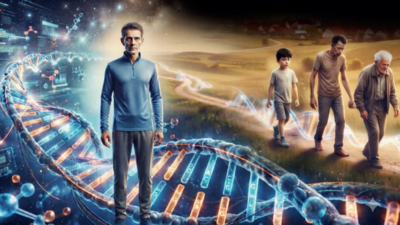
MUMBAI: For 48-year-old Andheri resident Kamal, tumours have stalked his family relentlessly for the past two decades. The condition claimed his father in 2006, before striking Kamal, then his sister and her daughter, and now his 13-year-old nephew.It’s written into a family’s DNA, passed down through generations — sending siblings, uncles, parents and children rushing to hospitals just years apart. Age is no barrier.
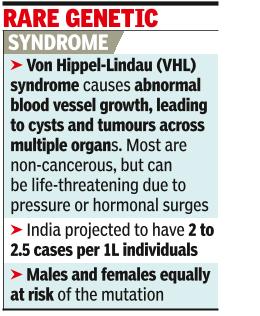
Rare genetic
Such is the nature of Von Hippel-Lindau (VHL) syndrome. It’s an autosomal dominant genetic disorder, meaning a person needs only one copy of the mutated gene from one parent to develop it, causing tumours and cysts in organs like the brain, kidneys, eyes, and, more commonly, the adrenal glands.Kamal, a marketing professional, said his tumour was first discovered in his brain in 2009. Another tumour appeared in his brain in 2016, and by 2019, lesions were found in his kidneys. Over the years, he made dozens of visits to general physicians and specialists, but a diagnosis was made only in 2019, after he reached civic-run KEM Hospital, Parel.
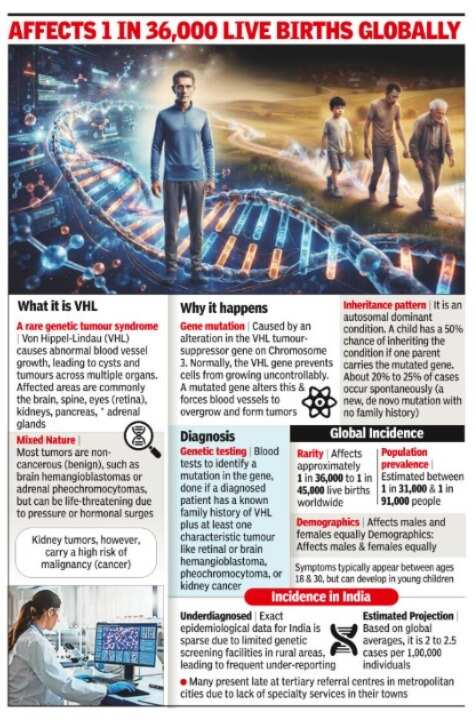
Affects 1 in 36,000 live births globally
So far, eight members of his family have undergone genetic testing; four tested positive, and tumours have already developed in three of them. “We had no idea for years. By the time it came to my sister and nephew, at least we knew where to go and what to expect,” Kamal said.At KEM, his 13-year-old nephew, Harsh, is being cared for by older cousins and relatives in rotational shifts. His 23-year-old cousin said, “My side of the family has not shown any signs so far. For a while, we thought this disease would stop at Kamal uncle and his sister. Now, Harsh is the third generation impacted; he has a brother who has no symptoms yet.”Thirty-year-old Manali Kanade said she too, like Kamal, has had tumours appear in multiple organs since her first one at 14. So has her sister’s 18-year-old son, who had an incident of severely high blood pressure at the age of just three. “For both of us, the start was an increase in blood pressure,” said Kanade. This was also the case with Kamal’s nephew and for Bhagwat Giri (23), a resident of Basmat taluka in Hingoli. “High BP, fever, and even seizures. We went to Nanded first, where the doctor told us to either visit a private hospital and spend several lakhs or visit KEM in Mumbai.”He was operated on at KEM Hospital during peak Covid-19 in 2021; last month, his sister, Vaishnavi, a Class XII student, was operated on for the same tumour after showing similar high BP signs as her brother.The hospital’s endocrinology department head, Dr Tushar Bandgar, said that in patients with VHL, tumours called pheochromocytomas commonly grow inside the adrenal glands, causing sudden surges in blood pressure. “Instead of releasing stress hormones like adrenaline in small, controlled amounts, these tumours release massive quantities.”The usual treatment is surgery to remove the tumour, and often the entire adrenal gland containing it. Dr Sameer Rege, who has operated on a number of such cases at the hospital, said, “During surgery, the risk is so high that at any given instance, blood pressure can shoot up and suddenly release a stress into the body, which can lead to death on the operating table.”Dr Nalini Shah, who headed the department until 2018, now runs Pheo Para Foundation, which has been helping families affected by pheochromocytoma access genetic testing and receive long-term support. At the hospital, Dr Bandgar and Dr Shah, together with their residents and colleagues, have been treating patients using amlodipine as a first-line preoperative medicine. Amlodipine belongs to a group called calcium-channel blockers. It relaxes the muscles in the walls of blood vessels, allowing the vessels to widen. As a result, blood pressure comes down. Traditionally, most doctors use phenoxybenzamine, which KEM doctors say has more side effects and is costlier. Dr Bandgar added that the preoperative protocol keeps patients stable using amlodipine, and the hospital’s in-house, small-scale studies published in peer-reviewed journals have shown promising results, though large-scale studies will be needed.Meanwhile, for the rest of Kamal’s family, whether to take a genetic test now or once symptoms kick in remains the question.