










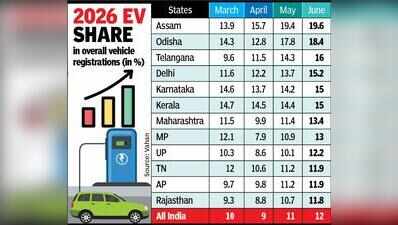
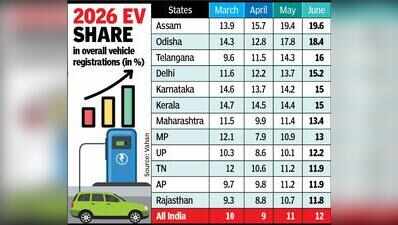
Chennai: At least a dozen states recorded double-digit electric vehicle (EV) penetration in June, with Assam and Odisha emerging as the frontrunners as EVs accounted for nearly 20% of new vehicle registrations—the highest penetration recorded by any Indian state to date.The sharp rise in crude oil prices following the West Asia conflict, coupled with a supportive policy environment and the steady expansion of charging infrastructure, appears to have accelerated India’s transition to electric mobility.The June quarter also defied the usual moderation in vehicle sales that typically follows the March year-end peak, with the share of battery-powered vehicles rising steadily month after month. The trend assumes greater significance as estimates suggest that raising EV penetration from the current level of 10% to 20% of all new vehicle registrations by 2030 could help India save nearly Rs 1 lakh crore annually on its crude oil import bill.India’s economy has continued to post strong growth despite the prolonged West Asia crisis since Feb 2026, reflecting a gradual decline in its dependence on crude oil. Oil intensity—measured as oil consumption relative to GDP—has nearly halved from 1.4% in FY14 to 0.7% in FY26, while crude oil imports as a share of GDP have fallen from 8.6% in Q2 FY14 to 3.1% in Q2 FY26, according to a note by SBI Research.The reduced dependence on oil has been driven by several structural changes, including the replacement of diesel-powered agricultural pumps with solar pumps, the rapid expansion of metro rail networks, greater use of renewable energy and the growing adoption of electric vehicles, it added.According to the report’s projections, annual vehicle registrations in India are expected to rise from 2.9 crore in 2025 to around 4 crore by 2030. Of these, about 80 lakh vehicles, or 20%, could be electric, compared with 15.7 lakh EV registrations in 2025. Between 2027 and 2030 alone, an additional 35 lakh EVs could replace petrol-powered vehicles compared with the business-as-usual scenario. This level of EV penetration could reduce India’s crude oil import bill by nearly Rs 1 lakh crore annually while lowering exposure to volatile global energy markets.Among other measures, the creation of a government-backed EV Credit Guarantee Fund covering EVs as well as charging and battery-swapping infrastructure is expected to reduce lending risks, lower borrowing costs and improve access to finance for MSMEs and retail buyers. It also recommended accelerating the rollout of charging infrastructure by extending Viability Gap Funding (VGF) and providing concessional land for public charging stations.