








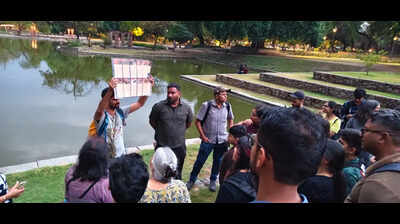
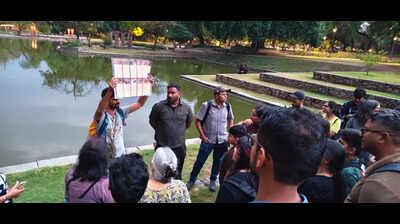
To mark International Bat Appreciation Day, a first-of-its-kind fold-out publication on the bats of Delhi NCR was launched, aimed at making knowledge about these nocturnal mammals more accessible to the public. The event was followed by an immersive Bat Walk led by Dr Rohit Chakravarty at Sunder Nursery, Delhi, bringing citizens closer to the often-overlooked world of bats in the capital.The guided walk introduced participants to the diversity of bat species inhabiting Delhi. Using bat detectors, attendees experienced the unique opportunity to listen to and interpret bat vocalisations in real time, gaining insights into how bats navigate, forage, and interact after dusk.Dr Rohit Chakravarty, Bat researcher at Centre for Wildlife Studies, said, “The biggest problem that bats face is their bad reputation. The fear and misunderstanding come because most people haven’t seen bats up close or learnt more about their behaviour. Such walks have the potential to change public perception of bats and create a well-informed citizen base that will lobby for bat conservation.”The newly released fold-out publication, developed by WWF-India in partnership with Nature Conservation Foundation (NCF), Centre for Wildlife Studies (CWS), and Bat Conservation International, documents 12 out of 15 bat species recorded in Delhi NCR. Designed as a compact, easy-to-use field guide, it includes species identification details such as size, habitat, diet, and behaviour, along with information on where these bats can be spotted throughout the city.Speaking on the initiative, Neha Raghav, Director-Environment Education, WWF-India, stated, “Bats are among the most misunderstood animals in our cities. Most people know them through myths rather than facts. This first fold-out field publication, ‘Bats of Delhi NCR’ is an important step in changing that narrative. It not only builds awareness but also serves as a practical, pocket-friendly field guide that people can carry and use outdoors. With species identification on one side and essential information on bat ecology, behaviour, and myths on the other, it makes learning accessible and engaging. Along with guided walks, it helps replace fear with curiosity and fosters a deeper appreciation for bats as pollinators, seed dispersers and natural pest controllers.”The field publication also features illustrations of bat anatomy, explains their ecological roles, and addresses common myths and misconceptions, making it a practical resource for citizens, students, and nature enthusiasts alike.Delhi NCR supports 15 bat species, reflecting the region’s rich urban biodiversity. These species play vital ecological roles as pollinators, seed dispersers, and natural pest controllers, helping maintain ecological balance in the city. Despite their importance, bats continue to face multiple threats, including habitat loss due to the decline of old trees and heritage structures, rapid urbanisation, pesticide use, and misinformation-driven persecution.By combining an engaging field experience with a practical educational tool, the initiative highlighted bats as an integral yet underappreciated component of Delhi’s biodiversity. Efforts such as these play a crucial role in bridging the gap between science and citizens, fostering informed observation, and encouraging conservation action.