







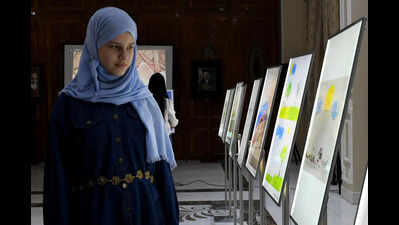
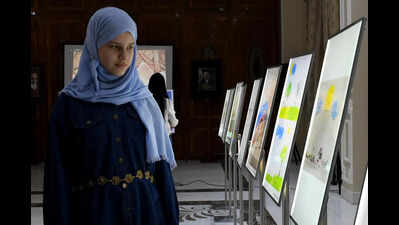
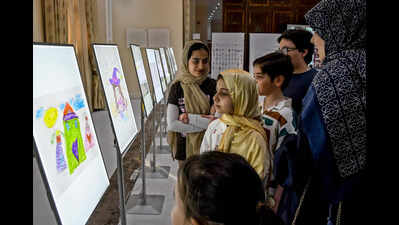
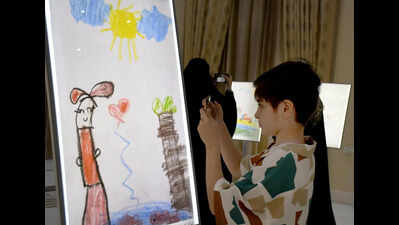
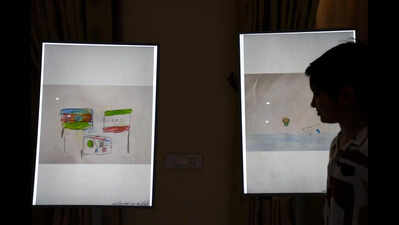
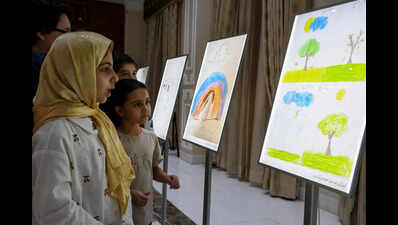
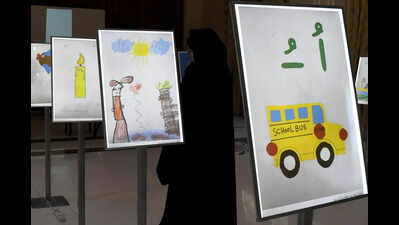
New Delhi: Roghayeg Salari, probably around five, had written her name in Persian across the top of a page that day — each letter in a different colour. Below it, faint traces of something she had erased still showed through. Her photograph, displayed beside this page at the Iranian embassy in Delhi, shows a young girl in a white hijab.This may have been among the last things Roghayeg did before a missile struck her school in southern Iran’s Minab on Feb 28 and took her life and that of 155 others, mostly children.On another page, two uneven hearts lean into each other. Inside one, a child has written in Persian, “I love my mother. When I go to school, I miss her.” The other reads, “I love my father and he drops me to school.”Twenty-eight such sheets, recovered from the debris of the Shajareh Tayyebeh girls’ elementary school, show simple, familiar images — a house under an open sky, birds, a school bus, a rainbow, a candle. Next to them are photographs of the children who drew them.Scanned copies of these drawings, recovered by Red Crescent rescue teams, have been brought to India and put on display by the embassy to draw the world’s attention to the innocent lives lost in the war.Titled ‘Minab Children Still Draw the Sun’, the exhibition opens with a poster filled with the kind of figures kids draw — a bright sun, an aeroplane, a car and a smiling figure. Inside, the walls hold scanned and restored versions of drawings — some torn, some smudged, all preserved just enough to be seen — pulled out of school bags that were buried in the debris.There is a brown fish with blue wings, marked with a star by a teacher. A fairy sits on a wand. Small, uneven sketches, the kind found in any classroom, now carry a different weight. Alongside them are rows of small, colourless photographs — resembling passport-sized images submitted for school forms — of the children who perished.One of the exhibition panels reads: “These are drawings that have been brought out from beneath the rubble of a school in Minab… Pages that were recovered through the efforts of the Red Crescent rescue teams, and have been restored only to the extent that they can be seen.” It adds, “The world depicted in them is still simple, bright and trustworthy — but the world outside did not remain so.”In the background, a song plays on a loop, accompanied by visuals of the destroyed school building. It tells the story of a father searching through the rubble for his daughter, only to find her lifeless body — a narrative that mirrors the intense grief shrouding the hall at the embassy.At the far end, photographs show rows of graves and coffins wrapped in the Iranian national flag, carried on the shoulders of grieving families.Officials at the embassy said the exhibition will remain open to the public from April 15 to 21, between 11 am and 4 pm. On Wednesday, children of Iranian diplomats walked quietly through the hall with their drawing teacher, stopping at each frame — looking at what children, perhaps their own age, had left behind.The aim is to draw global attention to the children killed in the conflict, embassy officials said, adding that similar exhibitions may be organised in other countries.Recently, in a symbolic gesture, images of the children killed in the Minab strike were placed on the seats of an Iranian govt flight to Islamabad. Iranian Parliament speaker Mohammad Bagher Qalibaf shared the images — placed on backpacks with roses — calling them his “companions on the flight.”The Minab strike, described by Iranian authorities as a targeted attack on a school, remains contested internationally. But inside the exhibition hall thousands of kilometres away, this debate feels distant. What tugs at our heartstrings are the drawings — and the memories of the children were behind them.