








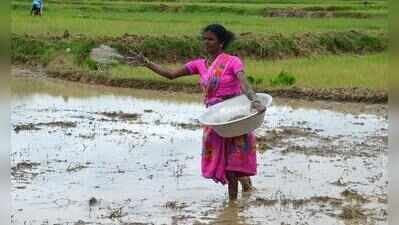
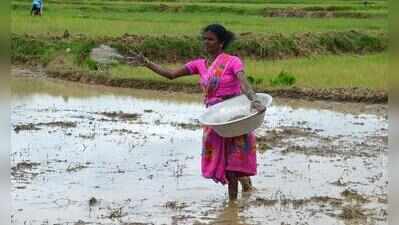
Ranchi: Recent rainfall has helped reduce Jharkhand’s rain deficit, but agricultural experts have cautioned that prolonged high-intensity showers could hurt transplanted paddy. Farmers have been advised to ensure proper drainage in paddy fields to prevent waterlogging and crop loss.Jharkhand cultivates rice on nearly 16-18 lakh hectares. Ranchi and other districts are now in a crucial Kharif planning phase, with farmers preparing nurseries and choosing crops amid a 42% rainfall deficit this year.Dr Sambhunath Karmakar, chairperson of the Department of Agronomy at Birsa Agricultural University, said the current spell of rain remains favourable for rice nursery preparation and has not significantly affected upland crops so far.“The rainfall pattern remains a major concern. Last year, continuous high-intensity rainfall created hindrance for sowing of upland crops and their interculturing operations,” he said.Farmers said paddy output was good last year, but continuous heavy rain from June 17 disrupted transplantation and other field operations.Experts have advised farmers to reduce dependence on upland paddy and diversify crops. Traditional varieties such as Brown Gora Dhan, known for its taste, have declined as farmers shifted to high-yielding varieties. For uplands, experts recommend maize, finger millet, urad, arhar, moong, groundnut, niger, soybean and khulti instead of rice. The ideal sowing window is June 20 to July 15.Districts such as Chatra, Latehar and Palamu remain vulnerable. Karmakar said drought mitigation in these areas would be difficult without rainwater harvesting and storage of surface water for crop-saving irrigation during dry spells.For mid-uplands, experts recommend maize-arhar intercropping. Ridge-and-furrow cultivation is considered safer in medium lands, while direct-seeded rice should be promoted where possible. In lowlands, farmers have been advised to complete land preparation before water stagnation.Experts also suggest staggered rice nurseries in two to three sets on different dates, as seeds take about 21 days to grow into proper seedlings.“A plan is already in place and that was done after holding meetings at various levels across all the districts in the state. Due to the threat of El Nino looming large, farmers have been advised to go for crop diversification. We are promoting sowing of arhar, urad and moong instead of rice and farmers will not incur losses due to change in weather conditions,” said Amritesh Singh, deputy director (general), Jharkhand Agriculture Department.He added that the department has produced a short awareness film and deployed 41 krishi raths across districts to educate farmers on best practices for the Kharif season.